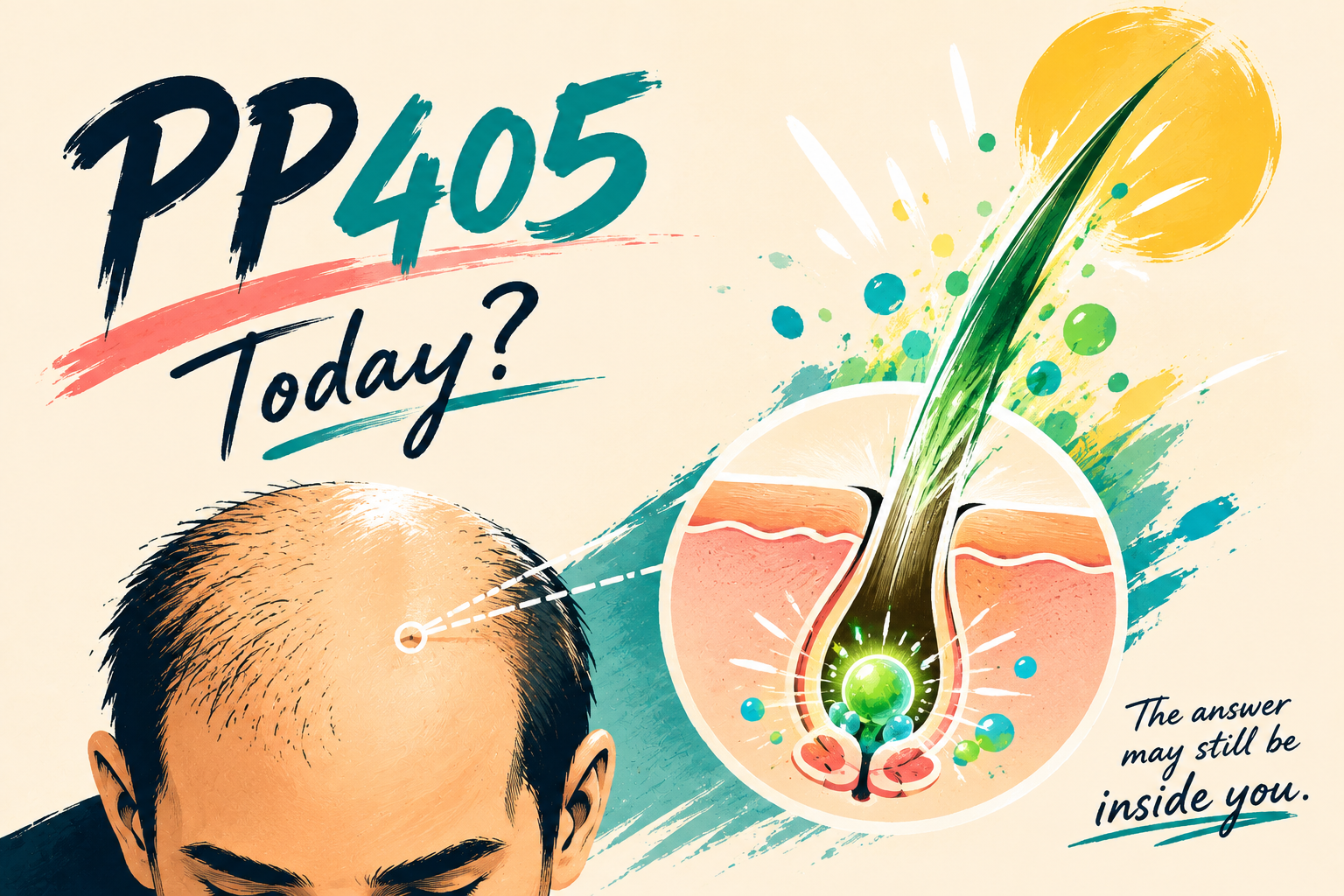
Once a laboratory idea, “waking dormant hair follicles” has now moved through human trials and toward the next stage of development. But the more interesting question raised by PP405 is bigger than a single drug: What, exactly, remains beneath the hair we think we have lost? And while that future moves closer, what can we do today?
To someone with a full head of hair, a single strand means almost nothing. A few hairs in the shower drain are easily ignored, and a strand on the pillow is simply brushed away.
But once hair loss begins, the value of a single strand changes.
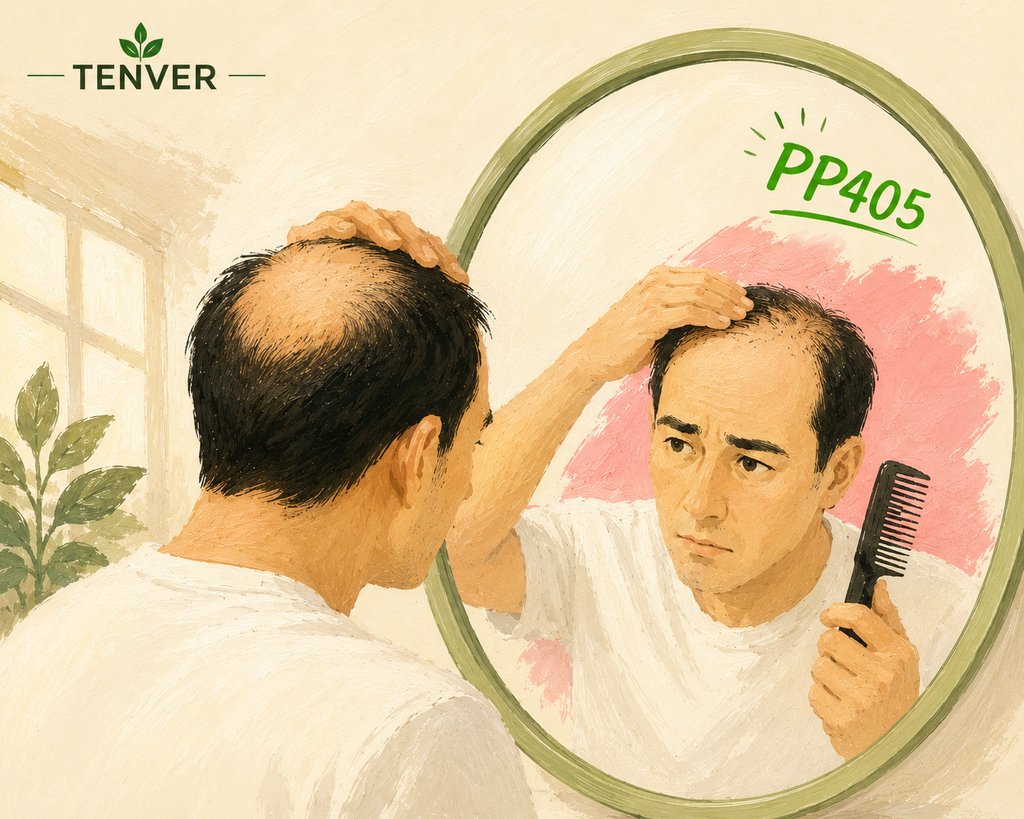
You shift your part from one side to the other in front of the mirror. You wonder whether your forehead looks slightly wider than it did yesterday. After a shower, you may even catch yourself counting the hairs left between your fingers. What was once disposable suddenly becomes something worth protecting.
For decades, hair-loss treatment has largely asked familiar questions: How can we slow the shedding? How can we keep the hair that remains thicker, longer?
Then scientists began looking more closely at the skin where hair had disappeared, and the question changed.
Because something appeared to be left behind.
The hair was gone. The stem cells were still there.
In 2011, researchers compared bald and non-bald scalp from men with androgenetic alopecia. They found that a population associated with hair-follicle stem cells remained even in bald scalp, while progenitor-cell populations involved in the next stages of hair production were markedly diminished. Read the original 2011 JCI study
The finding subtly changed the way hair loss could be imagined. At least in some androgenetic alopecia, the problem might not be that every regenerative component has vanished. Some stem cells may remain while failing to move efficiently into the next stage.
Is losing the hair the same thing as losing all biological capacity to make hair again?
A factory that has been demolished is very different from a factory whose production line has stopped. That does not mean every bald follicle is an intact factory waiting for someone to flip a switch. Some may have weakened after years of miniaturization; others may have undergone structural or environmental changes.
But the possibility was suddenly there:
perhaps the factory had not entirely disappeared.
The next question followed naturally.
Could it be restarted?
That question eventually led to PP405
In 2017, UCLA researchers focused on how hair-follicle stem cells use energy. In mouse studies, altering cellular metabolism influenced the activation of dormant hair-follicle stem cells and the hair cycle. One important target that emerged was the mitochondrial pyruvate carrier, or MPC. Read the original Nature Cell Biology study
This suggested a different approach to hair loss: rather than creating hair from the outside, perhaps medicine could reactivate cells that remain inside the follicle but have gone quiet.
PP405 emerged from that scientific lineage. It is an investigational topical small molecule designed to inhibit MPC and alter the metabolic state of hair-follicle stem cells, with the goal of encouraging dormant follicles to re-enter the growth cycle.
PP405 is not FDA-approved. But the idea is no longer confined to mice or laboratory speculation.
It has been tested in humans.
Then came the number: 31%
The Phase 2a study enrolled 78 men and women with androgenetic alopecia. Participants received PP405 0.05% topical gel or vehicle once daily, with 28 days of blinded treatment in the randomized portion. ClinicalTrials.gov lists the study as completed. View the official Phase 2a record — NCT06393452
The exploratory efficacy signal that attracted the most attention appeared among men with a higher degree of hair loss. At Week 8, 31% of PP405-treated men in that subgroup showed a greater than 20% increase in hair density, compared with 0% in the placebo group. Treatment itself had lasted four weeks, meaning the Week 8 observation came four weeks after dosing stopped.
That number needs to be read carefully.
It does not mean that 31% of all 78 participants regrew hair. It came from an exploratory analysis of a male subgroup with a higher degree of hair loss; the publicly available materials do not provide a denominator that allows the 31% to be converted into a count of the entire study population.
Once that limitation is acknowledged, however, a more interesting question appears.
In science, sometimes the people who do not respond can tell us as much as the people who do. If 31% showed a signal of possibility, perhaps the rest point toward the next question research needs to answer.
Why did some respond while others did not?
What if we are calling different biological states by the same name: “hair loss”?
Two people can appear equally bald. But does that mean the follicles beneath their skin are biologically identical?
One person may have follicles that are largely dormant. Another may have follicles weakened by years of miniaturization. In another, stem cells may remain while the surrounding environment has undergone inflammatory, fibrotic or other changes.
Two scalps can look equally bare while retaining very different capacities for recovery beneath the surface.
That leads to a useful way of framing the question.
‘Regenerative Reserve’
Medicine does not currently have a standard clinical measure for the amount of recoverable potential remaining in a person’s hair follicles.
But when these scattered findings are placed side by side, an intriguing question emerges:
Is the visible degree of hair loss really the same thing as the regenerative potential remaining beneath the skin?
For the purposes of this article, TENVER calls that possibility “Regenerative Reserve.”
Regenerative Reserve is not an established diagnosis, biomarker or clinical scale in hair-loss medicine. It is an analytical concept proposed by TENVER in this article to frame a question emerging across multiple lines of research.
Viewed this way, the 31% becomes more interesting. The future question may not simply be, “Does PP405 work?” It may also become: Which biological state of the follicle is most likely to respond — and could we someday know that before treatment begins?
Hair-loss medicine might eventually expand its question from “How much hair have you lost?” to:
“How much can still be recovered?”
There is reason for caution. A 2024 study using a different MPC inhibitor, UK-5099, in ex vivo human hair follicles found proliferative arrest rather than stem-cell activation. That study did not test PP405, and the compound, dose and experimental context were different, so it does not invalidate PP405’s clinical findings. But it reminds us that human follicle biology is unlikely to obey a simple rule that “MPC inhibition wakes dormant follicles.” Read the 2024 human-follicle study
Perhaps that is precisely why the 31% matters.
The next question may be not only whether a drug works, but for whom — and in what kind of follicle — it works.
TENVER VIEW
PP405 may ultimately succeed, fail, or find its place somewhere between those extremes. But its larger significance may already be visible.
For decades, hair-loss medicine has largely measured what is disappearing: hair count, density, diameter and the expanding area of loss. Regenerative approaches introduce a different question:
What biological capacity remains after the visible hair is gone?
TENVER’s idea of Regenerative Reserve grows from that distinction.
The concept is not a clinical test, and there is currently no validated way to assign someone a “regenerative reserve score.” But if future research can identify why one apparently dormant follicle responds while another does not, hair-loss treatment may eventually become less about classifying how bald someone is and more about identifying what remains biologically recoverable.
That would be a very different way of looking at baldness.
How close is PP405?
PP405 has already moved through Phase 1 and completed its Phase 2a study. According to ClinicalTrials.gov, the study enrolled 78 participants and was completed on October 1, 2025. That same month, Pelage Pharmaceuticals announced $120 million in Series B financing to support the next stage of PP405’s development.
Since then, the company has continued preparing for late-stage trials. In February 2026, Pelage expanded its executive and clinical-operations leadership, saying the changes were intended to support upcoming late-stage trials and that it planned to advance PP405 into late-stage clinical development during the year. In March, the company again stated that it expected to initiate late-stage studies in 2026.
But there is an important distinction between preparing for Phase 3 and actually beginning it. As of late August 2026, the publicly available ClinicalTrials.gov record for PP405 still shows the completed Phase 2a study; a Phase 3 PP405 trial is not yet publicly confirmed there as underway. The most accurate description of PP405’s position today, then, is this:
It has moved beyond early human testing and reached the threshold of late-stage development — but it would be premature to say that it has already crossed that threshold.
The size of the investment does not prove efficacy. Nor would entering Phase 3 guarantee eventual FDA approval. There are still important clinical and regulatory hurdles ahead.
But the opposite exaggeration should also be avoided. PP405 is no longer a speculative technology imagined for some distant generation.
It has already been tested in humans, completed Phase 2a, and is being prepared for large, late-stage clinical testing.
This brings to mind something that seems, at first, completely unrelated.
Some people choose cryonic preservation after death, entrusting their bodies to a future medicine that does not yet exist, hoping science might someday become capable of reviving them. No one knows when — or whether — that future will arrive.
For people losing their hair, fortunately, PP405 is not that kind of distant future.
There are still clinical and regulatory hurdles ahead, but this is no longer merely an idea waiting for another generation of science.
That changes the meaning of waiting.
Instead of simply waiting for the future to arrive, we can ask:
What should we preserve until that day comes?
At this point, the PP405 story leaves the laboratory.
It becomes a story about our own hair.It becomes a story about our own hair.
So what should I do until then?
Articles about experimental hair-loss drugs often end here: more trials are needed; approval will take time.
For someone whose hair is thinning today, that is not enough. Clinical research moves in years.
The hair in the mirror is changing now.
What we can do today is surprisingly unglamorous: avoid unnecessarily losing what we still have.
The first step is not adding something new. It is understanding what you are losing, and why.
If hair loss is progressing, make sure the diagnosis is actually androgenetic alopecia. Sudden shedding, sharply localized loss, scalp pain, redness, severe itching or scaling can point toward other causes. Hair loss has many causes, and finding the cause matters. AAD — Hair-loss diagnosis and treatment
If it is androgenetic alopecia, the next question becomes practical:
Can we slow the clock on follicles that are miniaturizing now?
Existing treatments still matter. Topical minoxidil is widely used for pattern hair loss, and finasteride is an FDA-approved option for male pattern hair loss. They do not work equally for everyone, and suitability, risks and side effects should be discussed with an appropriate clinician.
The important point is not to choose between PP405 and today’s therapies. Existing treatments are not obsolete drugs competing with a future regenerative treatment. Slowing miniaturization today and potentially reactivating dormant follicles tomorrow may address different moments in the same long process.
There is no clinical evidence that minoxidil or finasteride preserves a person’s future responsiveness to PP405. That line should be clear.
But there is equally little sense in allowing treatable hair loss to progress untreated for years simply because a more exciting therapy may be coming.
Before adding more, find out what is actually missing
I once bought a hair-loss supplement after reading a persuasive advertisement. The ingredients sounded almost indispensable for healthy hair.
Then the bottle arrived, and I looked carefully at the label.
I had to laugh.
Most of the ingredients being promoted for hair were already in the multivitamin I was taking.
That experience illustrates an important distinction:
A nutrient being necessary to make hair is not the same as more of that nutrient making more hair.
A car factory needs steel. But doubling the steel piled in the warehouse does not double the number of cars coming off the line. If production has stopped for another reason, what matters is not more steel.
It is finding out why the line stopped.
Hair deserves the same logic.
Inadequate protein or calories and deficiencies in nutrients such as iron can contribute to hair loss. If diet, symptoms or medical history suggest a deficiency, appropriate evaluation and correction make sense. But taking increasing amounts of nutrients simply because they are marketed for hair is a different proposition. The American Academy of Dermatology also notes that excessive intake of some nutrients, including selenium and vitamins A and E, has been linked to hair loss. AAD — Hair-loss management and nutrition guidance
The principle is simple:
Replace what is missing. Don’t keep adding what is already sufficient.
Extreme calorie restriction belongs in the same conversation. If the entire body is deprived of adequate energy and protein, hair can pay part of the price.
Take care of the place where the follicle lives
Hair follicles do not live in a vacuum.
Persistent dandruff, seborrheic dermatitis, severe itching or scalp inflammation should not simply be ignored. Treating those conditions does not cure androgenetic alopecia, but there is no reason to leave treatable scalp disease unmanaged while thinking about the future health of the follicle.
Preventable physical damage matters too. Hairstyles that repeatedly pull on the hair can cause traction alopecia and, when prolonged, may eventually lead to permanent loss. Repeated high heat, harsh chemical processing and rough handling can add unnecessary damage to already fragile hair. AAD — Traction alopecia and damaging hairstyles
That does not mean every scalp massage, special shampoo or oil should be promoted into a regenerative treatment. Something that feels pleasant or improves hair care is not automatically something that slows androgenetic alopecia or preserves future PP405 responsiveness.
The more useful question may be:
Before asking “What else can I add for my follicles?” ask “What damage can I stop imposing on them?”
Don’t turn your scalp into a laboratory out of impatience
Whenever an experimental drug attracts attention, products claiming a “similar ingredient,” “same pathway” or “research-grade” alternative tend to follow.
PP405 remains an investigational drug. There is no validated over-the-counter equivalent of PP405, and buying research compounds or MPC inhibitors online to experiment on your own scalp is not a sensible way to prepare for future medicine.
As the MPC research itself demonstrates, touching the same biological pathway does not make two compounds equivalent.
Acting on the same pathway is not the same thing as being the same drug.
For people interested in future PP405 studies, official trial information is the better route: ClinicalTrials.gov — NCT06393452 and Pelage PP405 trial information.
And then document it — photographs are not treatment; they are the dashboard
Take standardized photographs every three to six months: same lighting, same distance, same angles, including the hairline and crown.
But do not confuse photographs with doing something for the follicle.
Photographs are not treatment. They are the dashboard.
They can help show whether the strategy you chose appears to be working or whether the diagnosis or treatment deserves another look. The eye that sees the mirror every morning is remarkably poor at detecting gradual change. Two photographs taken months apart under the same conditions can be much less forgiving.
So photographs come after action.
First do what can reasonably be done.
Then measure what is happening.
Take your follicles with you until that day
For years, the hair-loss market has told us to add something: another shampoo, another supplement, another ingredient, another promise that this time it will be different.
Following the PP405 story to its logical end leads somewhere else.
If regenerative medicine really does move toward reactivating biological capacity that remains inside the follicle, our job today is not to imitate tomorrow’s medicine. It is to treat what can be treated, correct what can be corrected, and preserve what we still have for as long as reasonably possible.
None of today’s treatments or habits guarantees a future response to PP405.
But uncertainty is not the same thing as helplessness.
We are not simply waiting for PP405. We are taking our follicles with us until that day.
And for the person who began this story shifting a hair part from one side to the other in front of a mirror, this long scientific journey eventually returns to something very small.
One strand.
And beneath that strand, a possibility that may still be alive.
When the not-too-distant future arrives, having as much as possible left for medicine to treat — that may be the most realistic preparation we can make today.
PP405 is a story about the future. Your follicles are a problem of today.
Sources
- Garza et al., Journal of Clinical Investigation (2011) — Hair-follicle stem cells in bald scalp
- Flores et al., Nature Cell Biology (2017) — Lactate metabolism and HFSC activation
- ClinicalTrials.gov — PP405 Phase 2a, NCT06393452
- Pelage Pharmaceuticals — Publications & Press
- Pelage — AAD 2026 PP405 update and planned late-stage studies
- Pye et al., PLOS ONE (2024) — MPC inhibition in human hair follicles
- American Academy of Dermatology — Hair-loss management guidance
Related TENVER: What If Baldness Isn’t Permanent?
Leave a Reply