Semaglutide extended lifespan by about 12% in old mice. Could the drug we know for diabetes and weight loss be doing something much bigger inside the body?
Most drugs begin with a job description.
A blood-pressure drug is meant to lower blood pressure. A diabetes drug is meant to control blood sugar. We naturally connect one medicine with one disease. Hospitals are organized that way, pharmacies classify drugs that way, and our minds tend to do the same.
But every once in a while, a drug refuses to stay inside the box we built for it.
Sildenafil was not originally destined to become Viagra. It emerged from cardiovascular research, where an unexpected effect eventually opened an entirely different therapeutic path. Today, sildenafil is used not only for erectile dysfunction but also for pulmonary arterial hypertension.
Minoxidil has an even more memorable story. It was originally used as a powerful treatment for severe high blood pressure. Then doctors noticed something unexpected in some of the people taking it.
They were growing more hair.
At first, that was a side effect. Eventually, the side effect became a treatment, and minoxidil began a second life as one of the world’s best-known therapies for hair loss.
The drug had not suddenly acquired a new power.
We had simply discovered something it had been doing all along.
Why does medicine keep producing stories like these?
The Body Doesn’t Know Our Boundaries
The human body is not an office building with separate departments for diabetes, the heart, the kidneys and the brain.
There is no department manager standing at the door saying, “Sorry, this drug has nothing to do with us. Keep it out.”
Of course, the body has mechanisms that determine where a drug can go and how it can act. But blood circulates throughout the body. Hormones and neural signals move between organs. The same biological signaling system can perform different jobs in different tissues.
We divide disease into cardiology, endocrinology, nephrology and neurology because those divisions help us understand and treat illness.
The body doesn’t know those boundaries.
And sometimes, neither does a drug.
When a medicine changes one biological system for one intended purpose, something may happen somewhere we never expected to affect. If it helps us, we call it a therapeutic effect. If it harms us, we call it a side effect.
And occasionally, as minoxidil showed, yesterday’s side effect becomes tomorrow’s treatment.
That raises a slightly mischievous question.
If drugs can have benefits we haven’t discovered yet, why not take several good ones and hope something beneficial happens somewhere?
Because the body’s interconnectedness cuts both ways.
A drug may have benefits we have not yet discovered.
It may also have harms we have not yet discovered.
The body does not selectively accept only the effects we want. Different drugs can also act on overlapping biological systems and interact in ways we never intended.
This is also a useful way to think about one basic difference between nutrients and drugs. Replacing iron or vitamin B12 when someone is deficient is, broadly speaking, like supplying material the body needs to function normally. A drug more often goes a step further: it stimulates a signal, blocks one, or otherwise actively intervenes in what the body is doing.
That does not mean supplements are automatically harmless. Excessive doses can cause harm, and supplements can interact with medicines as well.
Semaglutide is clearly an intervention.
And this is where its story becomes interesting.
The Strange Journey of a Diabetes Drug
Semaglutide’s story began with blood sugar.
GLP-1 drugs were developed to help people with type 2 diabetes control glucose. But blood sugar was not the only thing that changed.
People lost weight.
The effect became so important that semaglutide eventually helped transform the treatment of obesity.
But the story did not stop there.
The heart appeared.
The kidneys appeared.
And eventually, important results began emerging even in people without diabetes.
In SELECT, researchers studied 17,604 people who were overweight or obese and already had cardiovascular disease, but did not have diabetes. Major cardiovascular events—cardiovascular death, heart attack or stroke—occurred in 6.5% of those receiving semaglutide and 8.0% of those receiving placebo, a 20% relative reduction in risk. Death from any cause was also lower: 4.3% versus 5.2%.
That invites an obvious question.
Wait. Doesn’t that mean they lived longer?
In one sense, yes. During the study period, people receiving semaglutide were less likely to die.
But that is not the same as showing that they aged more slowly.
Think of an old car.
If you dramatically reduce its risk of engine failure, the car may remain on the road longer. But that does not necessarily mean its metal is rusting more slowly, its rubber is deteriorating more slowly or its wiring is aging more slowly.
Preventing a breakdown is not necessarily the same thing as slowing the aging of the car itself.
The distinction matters just as much in humans.
Preventing heart attacks, strokes or other serious diseases can reduce the chance that someone dies. That is an enormous medical achievement by itself.
But it does not prove that the underlying biology of human aging has slowed.
A lower risk of dying is a signal.
Slower aging is a different claim.
Then, in September 2026, a study published in Nature brought those two stories unusually close together.
What Happened When Old Mice Received Semaglutide?
The researchers did not begin with young mice and treat them throughout their lives.
They started semaglutide in 20-month-old female mice—animals already well into old age.
Then they watched what happened.
Median lifespan in the control mice was 742 days.
In the semaglutide group, it was 834 days.
A difference of 92 days, or roughly 12%.
Ninety-two days.
It may not sound dramatic to a human reader. For a mouse, it is not a small amount of time.
If we recklessly applied the same percentage to an 80-year human lifespan, the arithmetic would come out to almost 10 years.
But this is exactly where we should put the calculator away.
Ninety-two days in a mouse does not translate into ten extra years in a human.
Mice and humans age differently, and this study involved one strain of female laboratory mice. The finding cannot tell us how much longer—or whether—people taking semaglutide would live.
The important question is not, “How many human years is that?”
What matters is that a difference of about 12% appeared in actual lifespan, one of the hardest endpoints biology can offer.
And lifespan was not the only thing that changed.
The treated mice also showed changes across measures of movement, physical performance, metabolism and cognition. When the researchers looked deeper, they found changes across multiple biological processes associated with aging rather than an improvement confined to a single organ or disease.
Which changes the question again.
Was semaglutide simply preventing a few more breakdowns?
Or was it touching some part of the process by which the whole organism grows old?
Or Did the Mice Simply Eat Less?
There is an obvious alternative explanation.
Semaglutide suppresses appetite. In this study, the treated mice ate about 24% less food.
And scientists have known for decades that calorie restriction can affect health and lifespan in laboratory animals.
So perhaps the story is much simpler:
They ate less → lost weight → became healthier → lived longer.
The researchers thought of that too.
They compared semaglutide treatment with calorie restriction designed to match the reduction in food intake.
There was substantial overlap. That matters. Some of semaglutide’s effects may indeed be connected to eating less and to the biological changes that follow.
But the two interventions were not identical.
On some measures, the semaglutide group and the calorie-restricted group followed different trajectories. That leaves open an important question: can reduced calorie intake alone explain everything semaglutide was doing?
It would be going too far to say that the study proved semaglutide slows aging independently of calorie restriction.
The evidence does not take us that far.
What it does allow us to ask is this:
Can everything this drug is doing be explained by the fact that it makes an animal eat less?
We don’t know yet.
That is precisely why the next studies matter.
So, Should I Take Semaglutide to Live Longer?
For now, no evidence supports that conclusion.
The lifespan extension occurred in mice, not humans.
In people, semaglutide has already shown important benefits in specific populations, including reduced cardiovascular risk. But that does not prove that it slows human aging or extends the lifespan of healthy people.
The participants in SELECT were not healthy people taking a longevity drug. They were overweight or obese and already had cardiovascular disease.
There are costs as well as potential benefits. In SELECT, adverse events leading participants to permanently stop treatment occurred in 16.6% of the semaglutide group compared with 8.2% of the placebo group.
Using semaglutide because someone has diabetes, obesity or another appropriate medical indication is therefore very different from a healthy person taking the drug in the hope of living longer.
A possibility can be scientifically exciting without being a reason to act on it today.
What matters now is where the evidence goes next.
Do humans taking GLP-1 drugs show coordinated changes across multiple systems associated with aging? Do those changes persist over years? Do they translate into longer healthspan, rather than simply fewer cardiovascular events? And eventually, do they affect lifespan itself?
Only then can the conversation move from a drug that reduces disease to one that may alter some part of the biology of aging.
TENVER VIEW
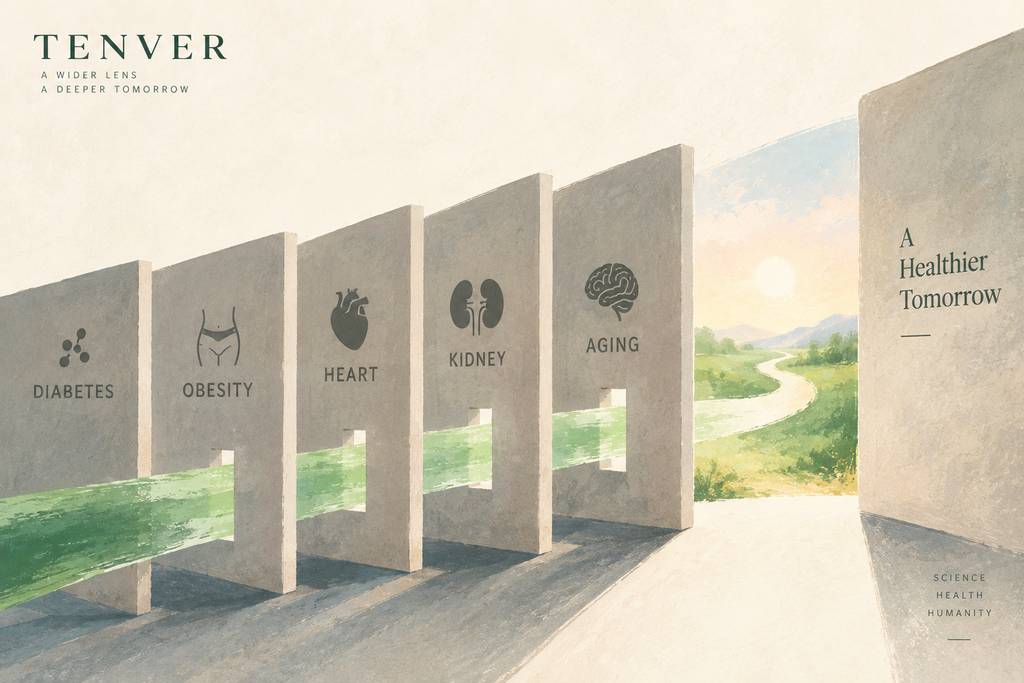
Put semaglutide’s story into separate boxes—diabetes, obesity, cardiovascular disease, kidney disease and aging—and each looks like a different piece of medical news.
Erase the boxes and place those findings back inside one human body, and a different picture begins to emerge.
Medicine has to divide disease into specialties. That division has allowed physicians and scientists to understand enormously complicated systems and treat them with increasing precision.
But metabolism, blood vessels, the brain, kidneys, the immune system and hormones do not operate according to the labels on hospital doors.
That is why TENVER’s question is not simply:
“Is semaglutide a longevity drug?”
There is a deeper question.
If a biological pathway first targeted for diabetes leads us through obesity, cardiovascular disease and kidney disease, and now into the biology of aging, could some of the conditions we treat as separate diseases share more underlying biology than their names suggest?
The histories of sildenafil and minoxidil remind us that medicines sometimes reveal effects in places we never expected to look.
The drug did not suddenly change.
Our understanding of the body did.
We do not yet know whether semaglutide slows human aging. There is no evidence that healthy people should take it simply to live longer.
What this new research gives us is not an answer.
It gives us a better question.
We have to divide disease to understand it.
But sometimes, to understand the body, we have to erase those divisions again.
Because the body was always one.
Sources
Feng Y, Barthez M, Wang Y, et al. Late-life semaglutide treatment slows ageing and extends lifespan in female mice. Nature 657, 469–476 (2026). Published online September 2, 2026.
Nature — Original Paper
Lincoff AM, Brown-Frandsen K, Colhoun HM, et al. Semaglutide and Cardiovascular Outcomes in Obesity without Diabetes. The New England Journal of Medicine 389, 2221–2232 (2023).
NEJM — SELECT Trial
Sattar N, et al. — Lancet Diabetes & Endocrinology (2021)
Cardiovascular, mortality, and kidney outcomes with GLP-1 receptor agonists in patients with type 2 diabetes.
PubMed — GLP-1 meta-analysis
Ghofrani HA, Osterloh IH, Grimminger F. — Nature Reviews Drug Discovery (2006)
Sildenafil: from angina to erectile dysfunction to pulmonary hypertension and beyond.
PubMed — Sildenafil history
Leave a Reply