Category: LIFE

  • When Normal Changes

    When Normal Changes

    What should we prepare for when the things we take for granted stop being taken for granted?

    Imagine a child sometime in the future watching an old video of a highway.

    Dozens of cars rush past, changing lanes, overtaking one another, peeling off toward different exits. The child watches for a moment, then asks, “Wait. People used to drive those themselves?”

    Perhaps one day, that question will not sound strange at all. Thousands of pounds of metal moving at highway speed, with the final decisions about steering and braking left to a human being who might be tired, angry, distracted, or simply wrong. To someone looking back from the future, what may seem remarkable is not that machines eventually learned to drive, but that we once considered this arrangement entirely normal.

    We do not know when fully autonomous driving will become ordinary, or whether it will unfold in the way its advocates expect. Technology alone cannot decide that. Safety, liability, law, insurance, infrastructure, and human trust all have to move with it. But the date is not what matters here. What matters is that something so ordinary today that we barely think to question it may one day cease to feel ordinary at all.

    Even the things we take for granted have an expiration date.


    When a Skill Stops Being Special

    When a new technology arrives, we tend to ask what it will eliminate. History suggests another possibility. Some skills do not disappear. They spread. What disappears is their scarcity.

    Typing was once a marketable skill. So was fast, accurate calculation. Knowing where and how to find information could itself be a form of expertise. Today we type more, calculate more, and retrieve more information than people in earlier generations could have imagined. Those abilities did not vanish. They became so common that we stopped treating them as special abilities.

    Recent research in labor economics points to a similar pattern over the life cycle of technologies. New technologies tend to demand greater skill when they first appear. As they standardize and spread, more people become capable of using them.¹ Yesterday’s expertise can become today’s baseline.

    There is no reason to assume AI will be entirely different. Today, people are learning how to “use AI well.” Courses teach prompt engineering. Advice circulates about how to phrase instructions so that a model gives a better answer. But if AI becomes increasingly capable of understanding ordinary human intent, someone in the future may find that period rather curious: “People had to learn how to talk to AI?”

    Step back far enough, and the history of computing reveals a striking direction. At first, humans learned the language of machines. We learned code, memorized commands, and adapted our intentions to rigid syntax. Then we clicked icons. We touched screens. Now, increasingly, we simply speak.

    Code → Command → Click → Touch → Conversation.

    This is more than the history of computers becoming easier to use. It is also a history of who is adapting to whom. For most of the computer age, humans had to learn languages machines could understand. Now machines are learning ours.

    Perhaps one dimension of technological progress is precisely this transition: from humans adapting to machines toward machines adapting to humans. If so, technological progress will not simply create an endless list of new things we must learn. It may also create a growing list of things we no longer need to learn.

    And that is where a more uncomfortable question begins:

    If something I spent years becoming good at is no longer special, where do I go next?


    Technology Does Not Just Replace Skills. It Unbundles Them.

    We tend to think of professions and abilities as intact packages. A photographer takes photographs. An accountant works with numbers. A writer writes. Technology rarely encounters those packages so neatly. It begins by taking them apart.

    Making a photograph, for example, has never consisted only of controlling focus and exposure. It also involves composition, timing, relationships with subjects, editing, taste, and storytelling. Technology automated some of those components and made others accessible to almost everyone.

    But the remaining abilities did not automatically become more valuable. Some became more important. Some shifted to customers. Some lost much of their market value. That is why we should be careful with one of the more comforting stories about technological progress: machines will take the simple work, and humans will naturally move on to higher work.

    History makes no such promise.

    Technology does not automatically push people upward. It breaks apart things we once treated as single abilities and changes which pieces remain scarce.

    The internet made information abundant. Once it did, merely possessing information mattered less than knowing what to look for and what to trust. Search engines reduced the cost of finding. AI is reducing the cost of something else: it can search, organize, compare, summarize, draft, code, generate images, suggest ideas, and produce alternatives.

    We are moving beyond an age in which information became abundant. We are entering an age in which answers themselves are becoming abundant.

    So what becomes scarce next? Good questions? Judgment? Creativity? Trust? Perhaps some of these will become more valuable. But we should resist the temptation to draw another protected circle and declare, “This, at least, will always belong to humans.”

    The search for the last uniquely human skill may itself be the wrong strategy. AI already helps formulate questions, compare possibilities, analyze evidence, generate ideas, and support decisions. There is no guarantee that a territory we label uniquely human today will remain untouched tomorrow.

    Perhaps what we are watching is not the discovery of humanity’s final protected ability. Perhaps we are watching a moving boundary.

    That changes the question:

    Instead of asking only what will disappear, ask what may become so common that it is no longer special—and what may become newly scarce because of it.


    A Better Starting Point Does Not Guarantee a Longer Journey

    One of AI’s most consequential effects may be its ability to move the starting point of thought.

    Knowledge has always accumulated because one person can begin where another person stopped. But reaching that frontier used to take time. We had to search, read, organize, compare, and understand what others had already discovered before we could begin asking our own questions. AI can compress parts of that journey.

    In one experiment involving professional writing tasks, people using generative AI completed the work roughly 40 percent faster while producing higher-quality results on average.² The experiment covered a limited class of tasks, but it demonstrates something important: for some forms of knowledge work, AI can substantially reduce the cost of reaching the point from which our own thinking begins.

    The next person may therefore be able to start farther ahead. That is different from simply doing the same work faster. The starting point of the next thought may itself be moving.

    But there is a trap hidden inside that advantage.

    Starting farther ahead does not mean we will travel farther.

    We can read an AI-generated summary and stop there. We can accept the first draft almost unchanged. We can choose among the options a system gives us and never ask what option was missing.

    Research on knowledge workers using generative AI has found that greater confidence in AI is associated with less effort devoted to critical thinking. At the same time, the nature of that thinking appears to shift—from gathering information toward verifying it, from solving problems directly toward integrating AI responses, and from executing tasks toward supervising them.³ AI may not simply reduce thinking. It may change where thinking happens.

    The same AI, then, can become a platform from which one person begins thinking at a higher level—and a reason for another person to stop thinking altogether. Having more room to think and using that room to think more deeply are not the same event.

    So perhaps the important question is no longer how far AI carried me.

    How much farther did I go from where AI left me?


    But Is That Time Really Mine?

    At this point, an attractive conclusion presents itself. If AI turns a three-hour task into a one-hour task, I have gained two hours. I can use them to think more deeply, learn something new, spend time with family, exercise, create, or rest.

    But there is a problem.

    Are those two hours actually mine?

    My employer may fill them with another assignment. Customers may begin expecting faster delivery. If one worker can produce more, the organization may simply raise the target.

    Research already points in more than one direction. In some workplace experiments, AI users have spent less time on certain tasks and reduced after-hours work. Other research examining technology exposure and time use has found settings in which work hours increase and leisure falls.⁴ Those findings need not contradict each other. They reveal a distinction that matters.

    Technology creating efficiency and that efficiency becoming someone’s time are not the same thing.

    The surplus created by efficiency can be absorbed by greater output. It can become corporate profit. It can reach consumers through lower prices. Under other arrangements, some of it may return to workers through higher wages or shorter hours. Technology does not decide the distribution.

    Efficiency creates capacity. It does not guarantee freedom.

    Higher productivity is not the same as saved time. Saved time is not the same as time I own. And even time I own is not necessarily time I am free to use as I choose.

    Who gets the capacity technology creates, and whose life actually becomes freer because of it? Those questions deserve more than a convenient answer. For now, consider only the portion that truly does return to us.

    It might be an hour. It might be the mental space released when a repetitive task no longer demands our full attention. It might be the ability to attempt something that once seemed beyond our reach. Only then does the next question become meaningful:

    Where will I put it?
    It is tempting to say that we should reinvest our recovered capacity in “higher-value” things. But higher by whose measure? Is writing one more paper inherently more valuable than spending two hours with a grandchild? Is starting another business more worthwhile than taking a long afternoon walk? If AI lets us finish early and we read a book, is that productive—but if we finally get enough sleep, is that wasted time?

    There is no universal ranking. Technology can create new possibilities for us. It cannot decide what constitutes a better life.

    For one person, the answer may be learning or building a business. For another, family, health, friendship, or creativity. For someone else, it may simply be rest that has been postponed for too long.

    What matters is not some abstract category called “higher value.” It is what we consider important enough to receive our finite time and attention.


    The Day the Old Way Starts to Look Strange

    So what should we prepare for when normal begins to change?

    We cannot learn every new technology that appears, nor should we try. But we can watch what is happening in our own lives. What am I spending significant time doing that is rapidly becoming easier? What do I still think of as a skill that is becoming a baseline capability? As that ability becomes common, what is becoming newly scarce? And of the capacity created by these changes, how much is actually becoming mine?

    These questions will not predict the future. But if we watch technologies unbundle abilities and make some of their components abundant, we may begin to see where scarcity is disappearing—and where it is beginning to reappear.

    Preparing for the future may not mean learning everything the future will require. It may mean noticing a little earlier what is becoming ordinary, and what becomes scarce because of it. Then we can reconsider where to place our own time and attention.

    We do not need to know the exact destination. Seeing the direction may be enough to begin moving.

    Normal rarely changes in a single dramatic moment. First, something new is remarkable. Then it becomes an option. Eventually, it becomes the default.

    And after a little more time, something curious happens:

    The new thing stops looking remarkable. The old way starts looking strange.

    That is when one version of normal quietly ends.

    Perhaps future generations really will ask: “People used to drive cars themselves?” “You opened dozens of websites one by one just to find information?” “People wrote the first draft of a report from scratch?”

    At the beginning of this essay, we let a child from the future look back at us. Perhaps now we should stand where that child is standing and look at our own present from the same distance.

    Of all the things I take for granted today, which one will my future self find hardest to believe?

    And if the day comes when I no longer have to do it myself—

    What will I put in the space it leaves behind?


    TENVER VIEW

    Perhaps preparing for a shift in what we consider normal is less about predicting the future than about learning to see the present as strange before the future arrives.

    Notice a little earlier what is becoming abundant, what becomes scarce as a result, and how much of the capacity created by that change actually becomes yours.

    If something truly does come back to you, move some of your finite time and attention—perhaps a little earlier than you otherwise would—toward what you believe matters most.

    AI does not give us the future.

    It gives us possibilities.

    Which of those possibilities will actually become ours? And what will we do with them?

    Perhaps the shape of the next era will depend not only on how far technology advances, but also on how we answer those two questions.



    Sources

    1. Tarek A. Hassan, Aakaash Kalyani & Pascual Restrepo, The Skill Premium in Times of Rapid Technological Change, NBER Working Paper No. 34939, 2026.

    2. Shakked Noy & Whitney Zhang, Experimental Evidence on the Productivity Effects of Generative Artificial Intelligence, Science, 2023.

    3. Hao-Ping Lee et al., The Impact of Generative AI on Critical Thinking: Self-Reported Reductions in Cognitive Effort and Confidence Effects from a Survey of Knowledge Workers, CHI 2025.

    4. Randomized workplace experiments and time-use research examining generative AI, working patterns, and the distribution of productivity gains between work and leisure.

  • Why Can’t We Just Become Friends by Chance Anymore?

    Why Can’t We Just Become Friends by Chance Anymore?

    We still encounter countless people. What may have changed is not how many people we meet, but how long they remain in our lives before a stranger has the chance to become someone.

    In the 1953 film Roman Holiday, Princess Ann does not set out to meet Joe Bradley. Escaping the suffocating formality of royal life, she slips into the streets of Rome, where the effects of a sedative eventually leave her asleep in public. Joe, an American reporter passing by, finds her without realizing that the young woman in front of him is a princess.

    Had they simply crossed paths and continued in opposite directions, there would have been no story. But one accident leads to another encounter, and the two begin moving through Rome together—walking, talking, laughing, accumulating the small memories through which a stranger gradually becomes a particular person.

    Cinema makes such encounters beautiful, but the beginnings of many real relationships are not so different. We became friends with someone because we happened to be assigned to the same classroom, hired by the same company, raised in the same neighborhood, seated at the same table through mutual friends, or drawn repeatedly to the same church, park, café or corner store. At the time, none of these circumstances seemed especially consequential. One encounter simply followed another until conversation accumulated into familiarity, familiarity into memory, and eventually a person who had once meant nothing in particular acquired a name in our lives: friend.

    We usually describe such relationships by saying that the friendship “just happened.”

    But did it?

    Perhaps what felt natural was not that friendship emerged from nowhere, but that society was quietly arranging so much of the encounter for us that we barely noticed the arrangement. Schools placed the same people in the same rooms day after day. Workplaces brought unrelated lives together for hours at a time. Neighborhoods, churches, parks, markets, cafés and local businesses created environments in which yesterday’s face could become today’s face and then tomorrow’s face again. We still chose whom to trust, whom to like and whom to love, but we did not have to choose from scratch whom we would have the chance to see again.

    Perhaps friendship was never quite as effortless as we remember.

    Society was doing more of the arranging than we realized.

    Meeting Someone Is Not the Same as Forming a Relationship

    The Korean thinker Shin Young-bok once used a striking image to describe a certain kind of modern human encounter: the meeting of billiard balls. Two balls certainly meet. They make contact, sometimes forcefully, but at the very moment of contact they are propelled away from each other along separate trajectories. There has been an encounter, but nothing accumulates between them.

    The metaphor may be even more revealing today because we are, in one sense, surrounded by more human connection than almost any generation before us. Our phones contain hundreds of contacts. Social media allows us to know where people we have never met went on vacation, what they ate and when they celebrated a birthday. On a subway in a large city, dozens of strangers may stand inches apart while remaining almost entirely absent from one another’s lives.

    Recent data suggest that the story is therefore more complicated than the familiar claim that modern people simply “have no friends.” In a 2025 Pew Research Center survey, 81 percent of American adults said they had at least one close friend outside their family, and people with close friends often communicated with them frequently through text, social media, phone or video. Yet only 29 percent said they saw a close friend in person at least a few times a week. We may not simply be becoming disconnected; we may be becoming connected differently.

    That raises a more interesting question. Among the thousands of people who pass through our lives, why do some remain strangers while a few become friends?

    One answer offered by social science is almost embarrassingly simple: we see them again.

    In a 2021 randomized experiment involving 2,966 students across 182 classrooms, researchers found that sitting next to another student increased the predicted probability of a mutual friendship from 15.3 percent to 22.3 percent. Children in classrooms are not adults navigating modern social life, so the finding should not be stretched beyond what it shows. But it offers unusually clean evidence for something researchers have long observed: physical proximity and repeated encounter can alter the probability that a relationship begins.

    Our own experience makes the mechanism easy to recognize. Someone we see once is a stranger; seen again, that person becomes “the person I saw yesterday.” Another encounter turns a stranger into a familiar face. Eventually there may be a name, then a greeting, then a conversation, and somewhere along that progression a quiet but consequential transformation takes place.

    A stranger becomes someone.

    Friendship may only become possible after that.

    Before We Care, We Have to See

    More than two thousand years ago, the Chinese philosopher Mencius recorded a scene that had nothing to do with friendship and yet captures something subtle about the way human feeling begins.

    King Xuan of Qi sees an ox being led away to be sacrificed in a ritual. Watching the frightened animal, the king cannot bear what he sees and orders that the ox be spared and a sheep substituted in its place. The obvious objection follows: if the ox deserves compassion, why not the sheep?

    Mencius is interested not simply in the inconsistency but in what caused the king’s compassion to awaken. The king had seen the ox; he had not seen the sheep.

    The original argument is political and moral. Mencius wants the king to extend the compassion he feels toward the animal before him to people beyond his immediate sight. But embedded in the story is an observation about the human heart that remains recognizable more than two millennia later: abstract existence does not move us as readily as particular presence does. Something changes when a being enters our field of attention and ceases to be one among many.

    Millions of people may live in our city, and billions may be theoretically reachable through a screen, but most remain abstractions. Then there is the person who appears every Saturday morning at the same café. The neighbor we repeatedly meet in the elevator. The person who runs at roughly the same pace beside us every Tuesday evening.

    Eventually the face acquires a name, the name acquires memories, and the memories begin to carry a small amount of concern. One morning the familiar person is absent, and for the first time we notice the absence.

    Perhaps relationships begin slightly earlier than we think—not with the exchange of phone numbers, not even with the first real conversation, but when one human being begins to become visible to another.

    Seen this way, several seemingly unrelated changes in modern life begin to look like parts of the same story.

    Convenience Removed More Than Inconvenience

    One of the great projects of modern life has been the removal of friction. We can bank without entering a bank, shop without entering a store and eat restaurant food without entering a restaurant. Entertainment comes to the living room, meetings appear on screens, and for many kinds of work it is now possible to complete an entire productive day without going to an office at all.

    Much of this is genuine progress. The time recovered from commuting is real. The flexibility of remote work can be enormously valuable, especially for people balancing work with children, caregiving, disability or geographic constraints. There is little reason to romanticize standing in lines, sitting in traffic or performing errands that technology can accomplish more efficiently.

    But we are very good at calculating what convenience saves and much less practiced at calculating what used to occupy the space we saved.

    We can measure the minutes no longer spent commuting, shopping or waiting for lunch. It is harder to measure the familiar faces that once inhabited those minutes: the person encountered on the morning train, the colleague who appeared in the same lunch place, the neighbor seen at a local shop, the barista who eventually knew an order without being told.

    Most of those encounters led nowhere. Riding the same train did not automatically produce friendship, nor did buying coffee from the same place.

    But that is precisely the point.

    Relationships emerge from a vast number of encounters in which, most of the time, nothing happens. Only a tiny fraction continue long enough for something to happen.

    It would therefore be far too simple to claim that delivery apps, online shopping or remote work have caused loneliness. Even recent research finding higher adjusted odds of loneliness among people working remotely three or more days a week is observational and cannot establish that remote work itself is the cause. The more interesting question lies underneath the argument over whether remote work is good or bad:

    When we removed friction from everyday life, did we inadvertently remove some of the coincidence as well?

    That question does not require us to restore the inconvenience. It asks whether we can preserve the freedom modern life has given us while recreating, in new forms, some of the human conditions that used to accompany it.

    And one important kind of relationship has already begun doing exactly that.

    Love Found a New Intermediary

    For much of modern history, romantic relationships also depended heavily on existing social networks. Friends introduced friends. Families made introductions. Schools, workplaces, neighborhoods and religious communities repeatedly placed strangers within reach of one another.

    As those traditional pathways weakened, however, romantic life did not simply wait for coincidence to return. Technology entered the space.

    Research by Stanford sociologist Michael Rosenfeld and colleagues found that, among heterosexual couples in the United States, meeting online overtook meeting through friends around 2013. Their paper described the internet as “disintermediating” friends and family—the traditional intermediaries who once connected potential partners.

    But there is another way to describe what happened.

    Technology removed an intermediary and then became the intermediary.

    When love could no longer rely as heavily on coincidence, we built new infrastructure for meeting. Among partnered Americans under 30 surveyed by Pew, one in five said they had met their current spouse or partner through a dating site or app.

    Now place friendship beside romantic love and a curious cultural difference appears.

    Saying “I’m looking for a partner” sounds perfectly ordinary. So does looking for a job, a home or almost anything else of lasting importance. Yet saying “I’m looking for a friend” carries a strangely different emotional weight. It can sound lonely, even vaguely embarrassing, as though friendship were one important thing in adult life that we should never appear to be searching for.

    Perhaps friendship remains one of the few relationships we still expect to arrive without our appearing to look for it.

    There may be a familiar cultural lag at work here. As we explored in “Why Does Adulthood Feel So Expensive?”, the conditions of modern life can change faster than the expectations we use to judge them. Something similar may be happening with relationships: the ways people meet are changing faster than our ideas about what a “natural” meeting is supposed to look like.

    But if the social conditions that once produced accidental friendship are changing, why should intentionally creating opportunities for friendship be considered artificial?

    Perhaps We Have to Create the Conditions for Chance

    There are signs that some people are already experimenting with an answer. Running clubs, book groups, hiking communities, craft circles and other recurring in-person gatherings have become prominent enough among younger adults that the phrase “community-maxxing” has recently been used to describe the search for more intentional offline social life. It is too early to declare this a broad social transformation, but it is an intriguing cultural signal: people may not be rejecting digital life so much as looking again for places where the same human beings can repeatedly appear in front of one another.

    At first, deliberately going somewhere in the hope of an accidental friendship sounds almost contradictory.

    But was the past really so different?

    A school friendship feels natural, yet someone designed the school, divided the grades, assigned the classroom and created the timetable that repeatedly put those two children together. A friendship at work may feel equally spontaneous, although an organization hired both people and brought them into the same place five days a week.

    The real difference, then, may not be whether encounters are arranged.

    It may be who does the arranging.

    In the past, institutions quietly arranged much of our repeated proximity for us. Increasingly, we may have to arrange some of it ourselves.

    That does not require surrendering the freedom modern life has created. Someone who can work remotely does not need to return to the office five days a week simply to prove that human contact matters. But perhaps there is value in choosing one or two days to go in—not merely to occupy a desk, but to be there on days when the same colleagues are there, to have lunch with them, to become part of one another’s ordinary weeks.

    A person working from home might choose to spend one afternoon each week in the same neighborhood café or coworking space. Someone who exercises alone because it is more efficient might reserve one evening for a recurring running group. A household that can have virtually everything delivered might still walk to the neighborhood market occasionally, not because shopping in person is technologically superior, but because a neighborhood only becomes socially meaningful when people repeatedly appear in it.

    None of these acts guarantees friendship, and that is important. Their purpose is not to manufacture relationships but to restore some of the conditions from which relationships can emerge.

    Remote work illustrates the distinction particularly well. If eliminating a commute returns an hour or two to someone’s day, there is no reason that time must be handed back to the employer. But perhaps some of it can be handed back to people—to an old friend, a regular gathering, a neighborhood café, a recurring class, or simply a place where familiar faces have the opportunity to become more familiar.

    Convenience gave us time back. The question now is where we choose to reinvest some of it.

    The same principle applies beyond individual choices. For employers concerned about social cohesion, the more useful question may not be simply how many days workers come to the office, but whether the same people are there at the same time often enough for relationships to accumulate. A company where everyone comes in twice a week on unrelated days may satisfy an attendance policy while recreating very little repeated proximity.

    Cities and communities might ask a similar question. A successful public space need not merely attract large numbers of people once; perhaps it should give the same people reasons to return. A successful community might measure not only how many attended an event but how many encountered one another again. And technology designed for social connection might eventually be judged not only by how many introductions it produces, but by whether those introductions have any realistic opportunity to become relationships.

    The challenge, then, is not to choose between freedom and connection.

    It is to ask a better question:

    How do we restore repetition without surrendering freedom?

    The answer does not have to begin with a major social program. It can begin with something much smaller: allowing ourselves to admit that we would like more friendship, choosing occasionally to do with others what could more efficiently be done alone, or returning to the same place at the same time rather than continually optimizing for novelty and convenience.

    What matters is not maximizing the number of people we meet.

    It is preserving in our lives the possibility of meeting the same people again.

    And this may also require us to reconsider what we mean when we call a relationship “natural.” A friendship formed in a running club is not artificial because someone joined the club hoping to meet people, any more than a marriage is less real because the couple first met through an app.

    Perhaps a natural relationship is not one whose beginning was accidental.

    It is one whose feelings were not forced after the beginning.

    We can design a place to meet. We can recommend people to one another. We can even increase the likelihood that the same people will meet repeatedly. What no institution or algorithm can determine is why we eventually notice when one particular person fails to appear, why we begin wanting to tell that person something that happened during our day, or why, among thousands of human beings, that person’s happiness or sorrow gradually begins to matter to us.

    That final distance still has to be crossed by human beings themselves.

    Why Can’t We Just Become Friends by Chance Anymore?

    Perhaps, then, we have not forgotten how to make friends. What may be disappearing is some of the time and space through which a potential friend moves from stranger to familiar face, from familiar face to a person with a name, and eventually from a name to someone who matters.

    Princess Ann and Joe Bradley meet by accident in Roman Holiday, but the reason their encounter has remained memorable for generations is not simply that two strangers happened to cross paths on a street in Rome. The accident continued. They spent time together, and during that time each ceased to be merely another person in the world and became a particular person to the other.

    Real friendship may not be so different.

    Every day we collide with other lives, sometimes like Shin Young-bok’s billiard balls, touching briefly before continuing along separate trajectories. But occasionally one encounter becomes a second, a face acquires a name, the name gathers memories, and eventually there comes a day when that person does not appear and we notice the absence.

    Somewhere in that long and almost invisible progression, an encounter becomes a relationship.

    What modern life may be short of, therefore, is not people. We already see and communicate with extraordinary numbers of them. What may be growing scarce is something quieter: enough repetition, enough time and enough shared presence for one human being to become someone to another.

    In the past, much of that human coincidence was supplied by the structure of everyday life. If less of it arrives automatically now, perhaps we should not simply wait for it to return.

    We can make room for it.


    TENVER VIEW

    For a long time, we have assumed that friendship should happen naturally. Yet many of the friendships we remember as spontaneous were nurtured by an invisible architecture of schools, workplaces, neighborhoods and communities that repeatedly brought the same strangers into one another’s lives.

    If that architecture is changing, deliberately seeking friendship may not be what is unnatural. What may be outdated is our expectation that friendship should still appear effortlessly under conditions that no longer produce as many repeated encounters.

    We do not need to reverse modern life to respond. There is no reason to surrender the freedom of remote work, abandon online convenience or manufacture unnecessary inconvenience. We can instead use a small part of the freedom we have gained to recreate some of the repetition we have lost—going into the office occasionally when the same colleagues will be there, returning to the same café, joining the same group at the same time each week, or simply leaving room in an optimized life for familiar faces to appear again.

    The point is not to meet more people.

    It is to give some of the people we meet a chance to stop being strangers.

    We cannot manufacture friendship, but we can create more of the conditions in which friendship becomes possible. Perhaps that is one of the small human tasks of a more convenient age: to restore repetition without surrendering freedom, and to give one another enough time to become someone.

    That may be where the next friendship begins.

    Sources

    Pew Research Center. “Where Men and Women Turn for Emotional Support and Social Connection.” January 16, 2025.
    Pew Research Center — Social Connection and Close Friends

    Rohrer, Julia M., Tamás Keller, and Felix Elwert. “Proximity Can Induce Diverse Friendships: A Large Randomized Classroom Experiment.” PLOS ONE, Vol. 16, No. 8, 2021.
    PLOS ONE — Proximity Can Induce Diverse Friendships

    Rosenfeld, Michael J., Reuben J. Thomas, and Sonia Hausen. “Disintermediating Your Friends: How Online Dating in the United States Displaces Other Ways of Meeting.” Proceedings of the National Academy of Sciences (PNAS), Vol. 116, No. 36, 2019.
    PNAS / PubMed Central — Disintermediating Your Friends

    McClain, Colleen, and Risa Gelles-Watnick. “From Looking for Love to Swiping the Field: Online Dating in the U.S.” Pew Research Center, February 2, 2023.
    Pew Research Center — Online Dating in the U.S.

    “Remote Work and Loneliness: Evidence from a Nationally Representative Sample of Employed U.S. Adults.” Journal of Affective Disorders, 2026. Based on data from 87,317 respondents in the 2024 U.S. Household Pulse Survey.
    PubMed — Remote Work and Loneliness

    Mencius. King Hui of Liang, Part I — the account of King Xuan of Qi, the ox and the sheep (“You saw the ox, and had not seen the sheep”). Chinese Text Project.
    Chinese Text Project — Mencius, King Hui of Liang

    The Guardian. “‘Community-maxxing’: Gen Z Are Done with Doomscrolling — and Ready to Socialise.” August 25, 2026.
    The Guardian — Community-maxxing

    Shin Young-bok. “Classic Lectures: Mencius.” Pressian, February 15, 2002. Shin discusses modern human relationships through his metaphor of “the meeting of billiard balls”—brief points of contact that end before they can develop into lasting relationships. The idea was later developed in his book Gangui: Naui Dongyang Gojeon Dokbeop, Dolbegae, 2004.
    Pressian — Shin Young-bok’s Classic Lectures

  • Why Does Adulthood Feel So Expensive?

    Why Does Adulthood Feel So Expensive?

    Buying a home, moving out, getting married, having children—each seems to be happening later. We often say younger generations simply want different things. But perhaps what changed first was not what they wanted. Perhaps it was the road they were asked to travel.

    Imagine someone approaching 30 who still lives with his parents. He graduated from college, has a steady job, contributes to household expenses, and saves part of every paycheck. He is not particularly extravagant, nor is he living entirely at his parents’ expense. Given today’s rents and home prices, staying home for a few more years while building savings may be one of the most rational financial decisions he can make.

    And yet, at a family gathering, someone asks:

    “You’re still living with your parents?”

    The question may be harmless, but it lingers. A friend buys a house. Another posts wedding photos, followed a year or two later by pictures of a new baby. Without meaning to, he begins measuring his life against theirs. He has a job. He is saving. He is planning for the future. And still, a thought creeps in: Why am I still here?

    To his parents’ generation, the situation may look even stranger. Many were already married at his age. Some had bought modest homes. Some already had children. And so it becomes easy to say that young adults today are taking longer to grow up.

    But is he really late? Or are we measuring his life with an old timetable?

    The Road Changed First

    For much of modern American life, adulthood was imagined as a fairly familiar sequence: finish school, get a job, leave your parents’ home, get married, buy a house, have children, then begin preparing for retirement.

    The past, of course, was never that simple. Earlier generations endured recessions and periods of punishingly high interest rates, while women and racial minorities faced barriers far greater than many do today. It would be historically careless to say that life was easy for previous generations and uniquely difficult for this one.

    Still, that sequence became a powerful social benchmark. We learned to judge where someone “should” be by a certain age, and milestones such as living independently, marrying, owning a home and having children became more than personal choices. They became visible evidence that someone had become an adult.

    But the timetable of actual life has already moved. In 1975, the median age at first marriage in the United States was 23.5 for men and 21.1 for women. By 2025, it had risen to 30.8 and 28.4. That same year, 58% of Americans ages 18 to 24 and 16% of those ages 25 to 34 were living in their parents’ home.

    It is tempting to explain this simply as a change in values, and values certainly have changed. Women have far greater economic independence and choice. Marriage no longer carries the same expectations it once did. Remaining child-free has become a legitimate life choice for many, while others value mobility and flexibility more than homeownership. It would therefore be equally simplistic to assume that young adults want exactly the same lives their parents had but simply cannot afford them.

    Place those changing values beside today’s economic conditions, however, and another picture begins to emerge.

    Between 2019 and 2024, inflation-adjusted median household income among U.S. households under 40 rose about 9%, while median home values rose roughly 30%. Add higher mortgage rates, and Pew Research Center estimated that typical monthly homeownership costs rose from $1,689 to $2,776—an increase of about 64%. Over the same period, the share of renters under 40 with enough income to afford those monthly ownership costs fell from 56% to 37%.

    But the more revealing part of the story is not simply that houses became more expensive. When it takes longer to afford a house, more than the date of a home purchase moves. Someone may stay with parents longer to save for a down payment. Delayed independence may alter marriage plans. High housing costs after marriage may affect when a couple feels ready for children. Student debt, retirement savings, insurance and childcare are all drawing from the same paycheck, which means these decisions can no longer be treated as separate financial events.

    That is what gets lost when we simply say, “Everything is more expensive now.” It is not only that the price of one future has gone up. Several different futures are now competing for the same paycheck.

    Save more for a house and another form of saving may have to wait. Pay off student loans first and the down payment takes longer. Have a child and housing costs suddenly coexist with childcare costs. Once financial pressure on one stage of life begins changing the timing of the next, money becomes something else.

    It becomes time.

    And from that point forward, economics alone can no longer explain the story.

    When Money Moves Time, Time Begins to Move Culture

    Deloitte’s 2026 survey of more than 22,500 Gen Z and millennial respondents across 44 countries found that 55% of Gen Z and 52% of millennials had delayed major life decisions because of financial concerns. Housing affordability and availability also affected career decisions and where to work for 69% of Gen Z and 64% of millennials.

    The revealing word here may be not “abandoned,” but “delayed.” Someone may still want a house but conclude that now is not the time. A couple may still want children but decide they need more stability first. A worker may want to change jobs but decide that giving up current security is a risk they cannot yet afford.

    Nor does this necessarily describe a generation that has given up on the future. In the same Deloitte survey, 53% of Gen Z and 45% of millennials expected their personal financial situation to improve over the following year. Many appear to be postponing decisions under pressure without abandoning the future they imagine for themselves.

    That distinction matters. When one person delays marriage for two years because of housing costs, it remains a private economic decision. When millions make similar decisions, something larger begins to happen. The average age of marriage moves. People remain with parents longer. The timing of homeownership and childbearing shifts. What begins as an adaptation to economic conditions can, if repeated long enough, become an ordinary way of living.

    Eventually, we stop calling it economic adaptation. We call it culture.

    So when we hear that young people marry later now, or that they care less about owning a house, another question is worth asking. Did values change first and produce new behavior, or did behaviors adopted in response to new economic conditions gradually become part of a new set of values?

    Reality is probably moving in both directions. Values have changed, and economic conditions have changed. What matters is that they do not move independently. Economics changes choices; repeated choices change culture; and the culture that emerges begins shaping the choices that follow.

    Some of what we casually describe as the personality of a generation may therefore be, at least in part, the imprint of the economic environment that generation encountered.

    That raises a more difficult question. If people’s actual lives have adjusted to new conditions, have our expectations of what a normal life should look like changed at the same speed?

    It does not appear that they have.

    Marriage ages have risen. Living with parents into adulthood has become more common. The economics of buying a home have changed dramatically. In other words, the timetable of actual life has already moved. Yet we still look at a 30-year-old living with parents and ask, “Still?” We still ask unmarried adults when they are finally going to settle down. And young adults themselves, fully aware of today’s economics, can still feel behind when a friend buys a house.

    Something important becomes visible here that individual statistics about housing or marriage tend to obscure:

    The economic timetable and the cultural timetable are moving at different speeds.

    The economic timetable responds relatively quickly to housing prices, wages, employment and education costs. People delay home purchases, remain with parents longer, and adjust marriage or childbearing plans. The cultural timetable is slower. It remains embedded in our parents’ experiences, comparisons with our peers, the families we grew up watching, and old assumptions about where someone “should” be at a certain age.

    That makes it possible to live rationally according to today’s economy while judging yourself according to yesterday’s timetable. Staying with parents and saving aggressively may be financially wise, yet still feel like a failure to launch. Delaying marriage may be the right decision for a couple, yet a friend’s wedding can still produce the uncomfortable sensation of being behind.

    The gap between economic time and cultural time is then carried not by society as an abstraction, but by individuals as emotion.

    The cost of adulthood may not be only financial. It may also be the cost of feeling late.

    Housing, rent, tuition and childcare can be measured in dollars. The cost of living rationally in one era while feeling that you have failed the expectations of another does not appear in any economic statistic.

    The Paradox of Family

    Follow that thought a little further and another paradox appears. We have long associated adulthood with becoming independent from one’s parents, yet as the price of economic independence rises, parental resources may become more important in reaching it.

    Someone who can remain at home for several additional years may save money that would otherwise disappear into rent. Parents who can contribute to a down payment may help a child enter the housing market sooner. Grandparents who can provide childcare may make it easier for two parents to remain in the workforce. Research on parental financial transfers and young-adult homeownership has likewise found an association between parental assistance and the transition into homeownership.

    This complicates the way we usually think about inequality. Imagine two 30-year-olds who each earn $80,000 a year. One can live with parents for several years and redirect what would have been rent toward a down payment. The other must pay substantial rent throughout those same years. Their incomes are identical, but it is difficult to imagine that their economic positions several years later will necessarily be the same.

    Income, in other words, may not be the only difference that matters. There may also be a difference in how long someone can afford to wait.

    Years in which someone does not have to rush out of the family home, years in which rent can become savings, or years in which relatives can help with childcare can all create room for the next decision. Seen this way, families may pass something to the next generation besides money and property.

    They may also pass down the ability to wait.

    There is a peculiar irony in that. In a society that has long treated independence from family as one of the clearest markers of adulthood, achieving independence may increasingly depend on what kind of family support a person has available.

    That, in turn, forces us to ask what we have actually been measuring when we call someone an adult. A home, a separate address, marriage, children and a stable career are visible. Responsibility, restraint, judgment and the ability to live with the consequences of one’s choices are much harder to see. Perhaps we have sometimes used visible economic outcomes as proxies for something far more difficult to measure: maturity.

    Maturity should not have a price tag. But many of the things we have used as evidence of maturity do—and their prices have changed.

    Owning a home, establishing a household and raising a family can remain deeply meaningful goals without requiring us to assume that the age at which someone reaches them is a reliable measure of how fully that person has grown up.

    Where Does Delayed Time Go?

    There is one more question, and it points forward. If buying a home happens later, and marriage and childbearing move later as well, it is tempting to imagine that the entire course of life simply shifts backward by several years.

    But not every clock in life moves together.

    Parents continue to age. Fertility has biological constraints. Retirement eventually arrives. Responsibilities delayed in early adulthood may therefore not disappear; some may meet one another later within a narrower stretch of life. A person may be raising children when aging parents begin to need care. A mortgage may coexist with college expenses and the need to accelerate retirement savings.

    In a 2025 survey, 54% of Americans in their 40s had both a parent age 65 or older and either a minor child or an adult child they were financially supporting—the group commonly described as the “sandwich generation.” Across all U.S. adults, the figure was 25%.

    It would be a mistake to claim that delayed marriage or homeownership caused this. Longer lifespans, support for adult children and many other forces are involved. But the phenomenon raises a question worth watching: are the stages of adult life simply moving later, or are housing, childrearing, eldercare and retirement preparation beginning to compress into a narrower portion of adulthood?

    If so, some of the rising cost of adulthood may not be paid only in dollars today. Time postponed earlier in life may return later in the form of overlapping responsibilities. That possibility requires much more study, but it suggests that “young people are doing everything later” may be far too simple a description of what is happening. The structure of time across adult life itself may be changing.

    And by this point, our view of the nearly 30-year-old still living with his parents has changed as well. At the beginning, we asked why he had not yet left home. But once his economic circumstances and the future he is preparing for are considered together, the more interesting question may no longer be why he has not yet become an adult.

    It may be what, exactly, we mean by adulthood now.

    Perhaps younger generations are not simply arriving later at the old destination. As the relationships among money, family, marriage and work change, the destination itself may be moving.

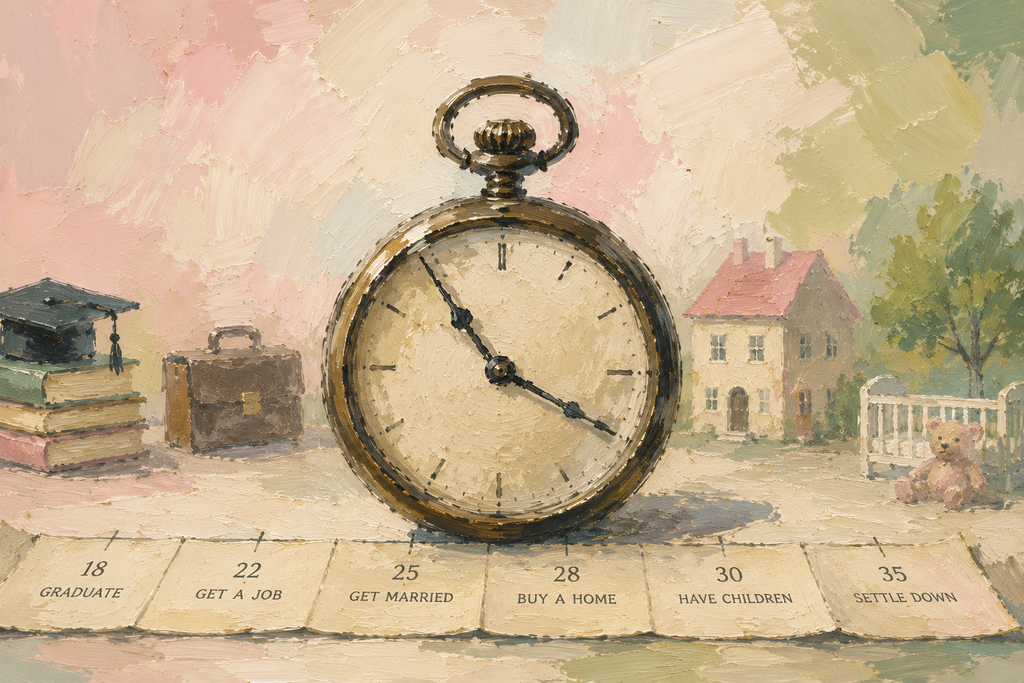
    The Old Clock

    For a long time, we have looked at a person’s age and used it to judge where that person should be in life. By 30, we imagined independence. Somewhere around there, marriage, a home and children were supposed to begin appearing too.

    But what if the road itself has changed?

    What if we are demanding the same arrival time from people who are no longer traveling the same distance?

    Personal responsibility still matters. Working hard, saving, making choices and accepting their consequences have not become irrelevant.

    But before declaring that an entire generation is running late, there is one thing worth checking.

    Are they really late—or are we still looking at an old clock?

    TENVER VIEW

    For generations, we have treated leaving home, marriage, homeownership and children not simply as life events, but as evidence that someone has successfully entered adulthood.

    The problem is that the price and timing of those milestones have changed faster than the expectations surrounding them.

    Perhaps the question, then, is not whether adulthood still requires responsibility. It does. The question is whether we should continue measuring that responsibility by a timetable built under different economic conditions.

    Responsibility and arriving “on time” are not necessarily the same thing.


    Sources

    U.S. Census Bureau — America’s Families and Living Arrangements: 2025
    Median age at first marriage and the share of young adults living in their parental home.

    Pew Research Center — Buying a Home Has Gotten Harder for Young Adults in Most U.S. Metro Areas
    Home prices, household income, mortgage costs and affordability among households headed by adults under 40.

    Deloitte — 2026 Gen Z and Millennial Survey
    A global survey of more than 22,500 Gen Z and millennial respondents across 44 countries, including financial pressures, housing concerns and delayed major life decisions.

    Harvard Joint Center for Housing Studies — The Role of Parental Financial Assistance in the Transition to Homeownership by Young Adults
    Research examining the relationship between parental financial transfers and young adults’ transition into homeownership.

    Pew Research Center — More Than Half of Americans in Their 40s Are “Sandwiched” Between an Aging Parent and Their Own Children
    Data on Americans simultaneously navigating responsibilities involving their children and aging parents.