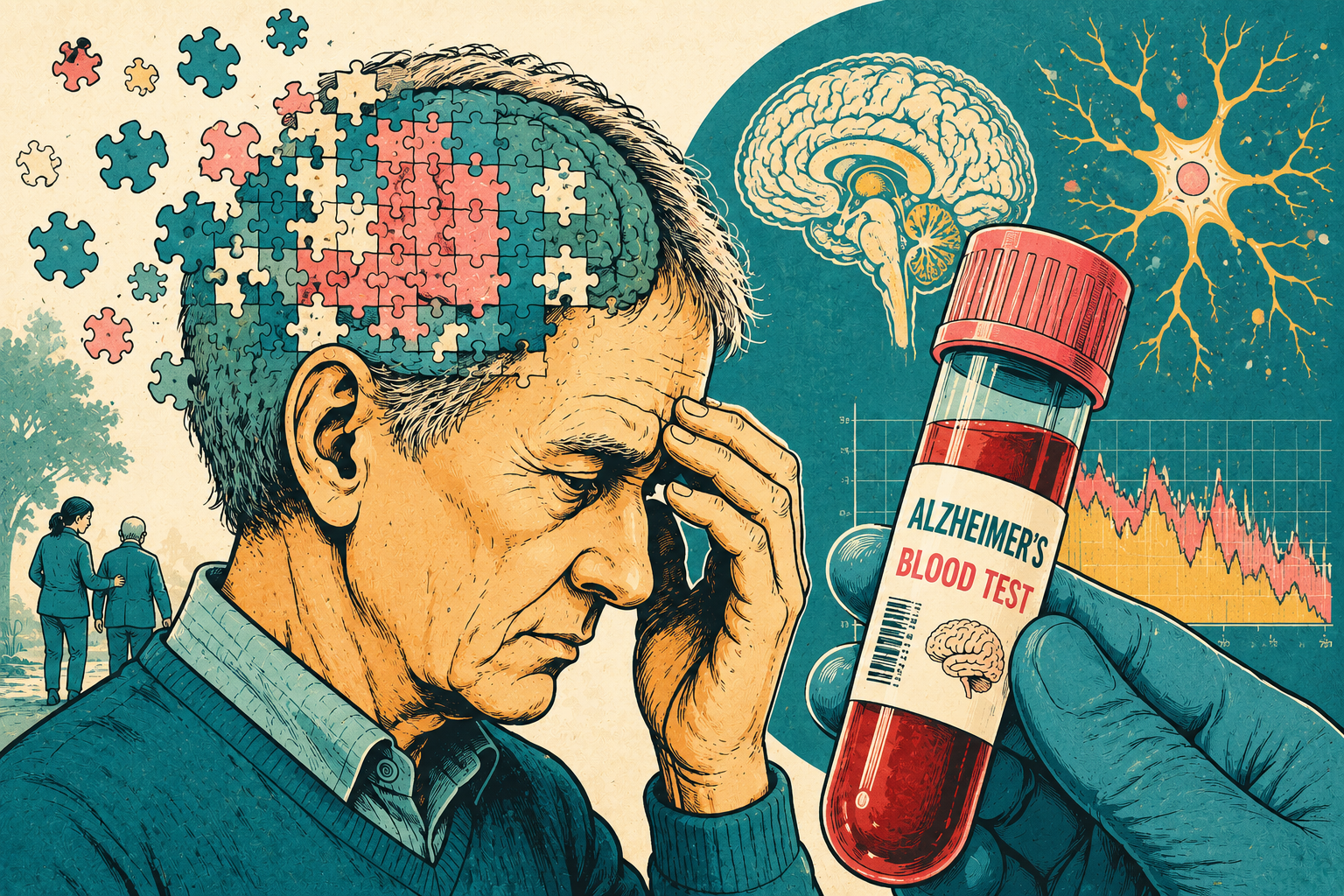
A New Blood Test Signals a New Era in Alzheimer’s Detection
For generations, Alzheimer’s disease has carried a particularly cruel uncertainty. A person begins forgetting names. A familiar route suddenly seems unfamiliar. A word that once came effortlessly disappears in the middle of a sentence. Families notice these small changes and eventually confront a frightening question: Is this simply aging — or is something happening inside the brain?
Until recently, answering that question could lead to specialized neurological examinations, expensive PET brain scans, or a lumbar puncture to analyze cerebrospinal fluid. Now, something as ordinary as a blood draw may begin to change that journey.
On August 19, 2026, the U.S. Food and Drug Administration cleared Elecsys pTau217, a new blood test developed by Roche in collaboration with Eli Lilly. Roche announced the clearance on August 24. The test is designed to help physicians determine whether a patient has the amyloid brain pathology associated with Alzheimer’s disease. It marks another major step toward something scientists have pursued for decades: finding evidence of Alzheimer’s-related changes in the blood.
What Is pTau217?
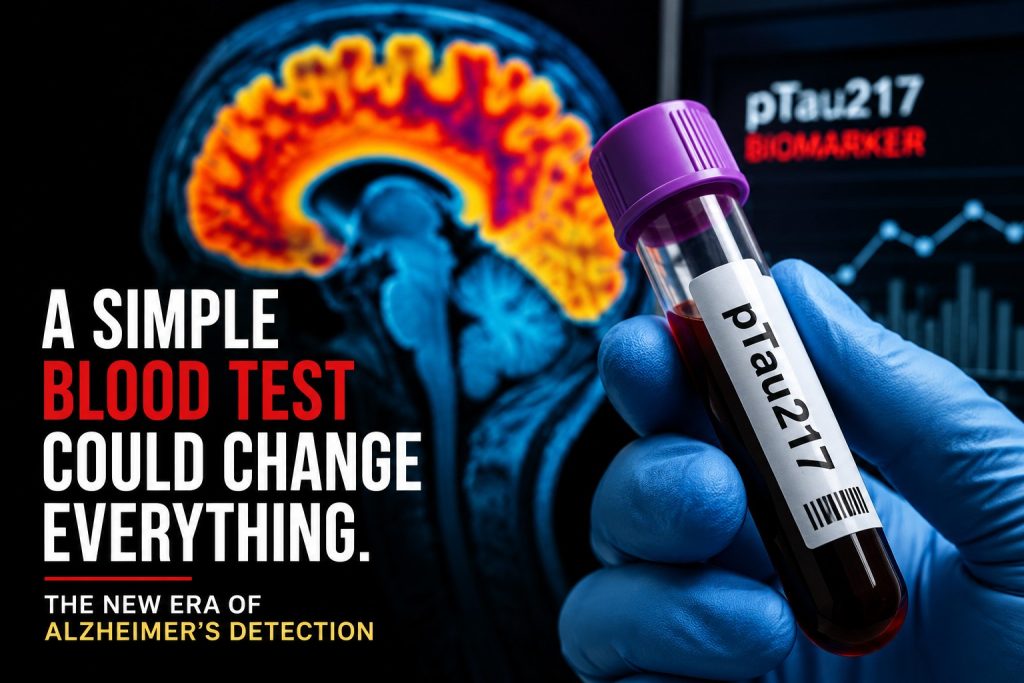
Two proteins have long been central to Alzheimer’s research: amyloid beta and tau. Amyloid can accumulate between nerve cells as plaques, while abnormal forms of tau are associated with damaging changes inside neurons. One particular form of tau — phosphorylated tau 217, or pTau217 — has emerged as an especially powerful blood biomarker for Alzheimer’s-related brain pathology.
What makes this development remarkable is where scientists can now measure that signal. Instead of looking directly inside the brain with a PET scanner or obtaining cerebrospinal fluid through a lumbar puncture, researchers can detect pTau217 in blood. The Elecsys test measures pTau217 in plasma and uses that information to help determine whether Alzheimer’s-associated amyloid pathology is likely to be present.
The test reports results in three categories — positive, intermediate or negative — helping physicians determine whether additional evaluation may be necessary. It does not replace a physician’s diagnosis, but it could make the first stage of investigating cognitive decline substantially simpler.
How Good Is It?
The scientific evidence behind pTau217 is what makes this development particularly compelling. In a 2026 study published in Alzheimer’s & Dementia, researchers evaluated the Elecsys pTau217 assay using samples from 2,148 people across five clinical research cohorts. Participants included people with cognitive impairment as well as people who appeared cognitively unimpaired, and researchers compared their blood results with amyloid PET imaging, an established method for detecting amyloid pathology in the brain.
Among cognitively impaired participants, those whose PET scans showed amyloid pathology had substantially higher pTau217 concentrations than those whose scans did not. The same general pattern appeared even among cognitively unimpaired participants. In other words, researchers were seeing in the blood a molecular signal closely associated with what PET imaging was revealing in the brain.
That relationship is why pTau217 has attracted such intense scientific interest. The goal is not simply to invent another laboratory test, but to find a reliable biological signal that can help physicians determine who is likely to have Alzheimer’s-related pathology and who may need more specialized evaluation.
Why a Blood Test Could Change Everything
PET imaging is sophisticated and valuable, but it is expensive and not readily available everywhere. Cerebrospinal fluid testing can also provide important information, but obtaining it generally requires a lumbar puncture. A blood sample is different: it can be collected in an ordinary medical office or laboratory.
Roche says its new test is designed to operate on more than 4,500 existing cobas laboratory instruments in the United States. That matters because much of the infrastructure needed to perform the test already exists. If blood biomarkers become routinely incorporated into medical practice, assessment for Alzheimer’s could gradually move beyond specialized memory clinics and neurological centers. A conversation that once might have begun with a specialist could increasingly begin in a primary-care physician’s office.
The implications could be especially important in communities where access to PET imaging or major neurological centers is limited. A blood test cannot replace all of those resources, but it may help physicians decide much earlier which patients truly need them.
Why Earlier Detection Matters More Now
There was once an uncomfortable question surrounding early Alzheimer’s diagnosis: Why discover the disease early if medicine could do little to alter its course? That calculation is beginning to change.
New disease-modifying treatments targeting amyloid pathology have emerged, while additional therapies are being investigated. These treatments do not cure Alzheimer’s. Their benefits can be modest, and their risks require careful consideration. But they introduce an important new reality: if treatment has its greatest opportunity to help during the earlier stages of disease, then identifying Alzheimer’s-related pathology earlier becomes increasingly valuable.
Diagnosis and treatment are therefore beginning to move closer together. A blood test could become one of the bridges between them — not because the test itself treats the disease, but because it may help identify the disease process at a point when medical decisions can potentially matter more.
What This Test Cannot Tell You
There is an important caution. Elecsys pTau217 is not a stand-alone test that tells someone, “You have Alzheimer’s disease.” The FDA-cleared use is for people 55 and older who already have signs, symptoms or complaints of cognitive decline. It is not intended as a general screening test for healthy people who simply want to know whether they might develop dementia decades from now.
Nor does a positive result automatically mean that someone has dementia. The test helps determine the likelihood of amyloid pathology associated with Alzheimer’s disease. Physicians must interpret the result together with symptoms, medical history, cognitive assessment and, when appropriate, additional diagnostic testing. The test also has not been established for predicting whether a person will eventually develop dementia or for monitoring whether an Alzheimer’s treatment is working.
That distinction matters. This is powerful science — but it is not fortune-telling.
The Larger Revolution
Perhaps the most important part of this story is not this particular test, but the direction medicine is moving. For much of medical history, the living human brain has been extraordinarily difficult to examine. Doctors often had to infer what was happening inside it from behavior, memory tests and neurological symptoms. Then came sophisticated brain imaging. Now, molecules circulating in the bloodstream are beginning to reveal biological changes associated with what is happening inside the brain.
The latest Elecsys test is particularly notable because a single biomarker — pTau217 — can support both rule-in and rule-out assessment of amyloid pathology, using validated clinical cutoffs across primary and specialty care. It is part of a rapidly developing field of blood-based biomarkers that could eventually alter how physicians approach one of the most feared diseases of aging.
What once required a highly specialized diagnostic pathway may increasingly begin with something remarkably ordinary: a tube of blood.
Before Memory Fades
Alzheimer’s disease remains one of medicine’s most formidable challenges. A blood test does not cure it. It cannot restore a forgotten name, a lost memory or a familiar face that has become difficult to recognize. But it may shorten the painful period of uncertainty between the first troubling signs and an explanation.
And as treatments continue to advance, time itself may become increasingly valuable. Earlier knowledge may give physicians more time to evaluate treatment options, families more time to plan, and patients more opportunity to participate in decisions about their own future.
For decades, medicine often recognized Alzheimer’s by what a person had already lost. The emerging science of blood biomarkers points toward a different future: one in which we may be able to see the disease process earlier — while there is still more memory left to protect.
TENVER VIEWS
The real significance of this breakthrough is not that Alzheimer’s can suddenly be cured — it cannot. It is that medicine may be shifting the timeline of the disease. For decades, Alzheimer’s was largely recognized after memory had already begun to disappear. Blood biomarkers such as pTau217 raise the possibility of identifying the biological signs of the disease earlier, more simply, and far more widely than before. As treatments improve, those additional months or years could become increasingly valuable. The future of Alzheimer’s medicine may depend not only on finding better treatments, but on finding the disease while there is still more of the person left to protect.
Sources & Further Reading
Roche Diagnostics. FDA clearance information for Elecsys Phospho-Tau (217P) Plasma, August 24, 2026.
This article is for informational purposes only and does not constitute medical advice. Alzheimer’s disease and cognitive impairment should be evaluated by qualified healthcare professionals.
Leave a Reply