
What should we prepare for when the things we take for granted stop being taken for granted?
Imagine a child sometime in the future watching an old video of a highway.
Dozens of cars rush past, changing lanes, overtaking one another, peeling off toward different exits. The child watches for a moment, then asks, “Wait. People used to drive those themselves?”
Perhaps one day, that question will not sound strange at all. Thousands of pounds of metal moving at highway speed, with the final decisions about steering and braking left to a human being who might be tired, angry, distracted, or simply wrong. To someone looking back from the future, what may seem remarkable is not that machines eventually learned to drive, but that we once considered this arrangement entirely normal.
We do not know when fully autonomous driving will become ordinary, or whether it will unfold in the way its advocates expect. Technology alone cannot decide that. Safety, liability, law, insurance, infrastructure, and human trust all have to move with it. But the date is not what matters here. What matters is that something so ordinary today that we barely think to question it may one day cease to feel ordinary at all.
Even the things we take for granted have an expiration date.
When a Skill Stops Being Special
When a new technology arrives, we tend to ask what it will eliminate. History suggests another possibility. Some skills do not disappear. They spread. What disappears is their scarcity.
Typing was once a marketable skill. So was fast, accurate calculation. Knowing where and how to find information could itself be a form of expertise. Today we type more, calculate more, and retrieve more information than people in earlier generations could have imagined. Those abilities did not vanish. They became so common that we stopped treating them as special abilities.
Recent research in labor economics points to a similar pattern over the life cycle of technologies. New technologies tend to demand greater skill when they first appear. As they standardize and spread, more people become capable of using them.¹ Yesterday’s expertise can become today’s baseline.
There is no reason to assume AI will be entirely different. Today, people are learning how to “use AI well.” Courses teach prompt engineering. Advice circulates about how to phrase instructions so that a model gives a better answer. But if AI becomes increasingly capable of understanding ordinary human intent, someone in the future may find that period rather curious: “People had to learn how to talk to AI?”
Step back far enough, and the history of computing reveals a striking direction. At first, humans learned the language of machines. We learned code, memorized commands, and adapted our intentions to rigid syntax. Then we clicked icons. We touched screens. Now, increasingly, we simply speak.
Code → Command → Click → Touch → Conversation.
This is more than the history of computers becoming easier to use. It is also a history of who is adapting to whom. For most of the computer age, humans had to learn languages machines could understand. Now machines are learning ours.
Perhaps one dimension of technological progress is precisely this transition: from humans adapting to machines toward machines adapting to humans. If so, technological progress will not simply create an endless list of new things we must learn. It may also create a growing list of things we no longer need to learn.
And that is where a more uncomfortable question begins:
If something I spent years becoming good at is no longer special, where do I go next?
Technology Does Not Just Replace Skills. It Unbundles Them.
We tend to think of professions and abilities as intact packages. A photographer takes photographs. An accountant works with numbers. A writer writes. Technology rarely encounters those packages so neatly. It begins by taking them apart.
Making a photograph, for example, has never consisted only of controlling focus and exposure. It also involves composition, timing, relationships with subjects, editing, taste, and storytelling. Technology automated some of those components and made others accessible to almost everyone.
But the remaining abilities did not automatically become more valuable. Some became more important. Some shifted to customers. Some lost much of their market value. That is why we should be careful with one of the more comforting stories about technological progress: machines will take the simple work, and humans will naturally move on to higher work.
History makes no such promise.
Technology does not automatically push people upward. It breaks apart things we once treated as single abilities and changes which pieces remain scarce.
The internet made information abundant. Once it did, merely possessing information mattered less than knowing what to look for and what to trust. Search engines reduced the cost of finding. AI is reducing the cost of something else: it can search, organize, compare, summarize, draft, code, generate images, suggest ideas, and produce alternatives.
We are moving beyond an age in which information became abundant. We are entering an age in which answers themselves are becoming abundant.
So what becomes scarce next? Good questions? Judgment? Creativity? Trust? Perhaps some of these will become more valuable. But we should resist the temptation to draw another protected circle and declare, “This, at least, will always belong to humans.”
The search for the last uniquely human skill may itself be the wrong strategy. AI already helps formulate questions, compare possibilities, analyze evidence, generate ideas, and support decisions. There is no guarantee that a territory we label uniquely human today will remain untouched tomorrow.
Perhaps what we are watching is not the discovery of humanity’s final protected ability. Perhaps we are watching a moving boundary.
That changes the question:
Instead of asking only what will disappear, ask what may become so common that it is no longer special—and what may become newly scarce because of it.
A Better Starting Point Does Not Guarantee a Longer Journey
One of AI’s most consequential effects may be its ability to move the starting point of thought.
Knowledge has always accumulated because one person can begin where another person stopped. But reaching that frontier used to take time. We had to search, read, organize, compare, and understand what others had already discovered before we could begin asking our own questions. AI can compress parts of that journey.
In one experiment involving professional writing tasks, people using generative AI completed the work roughly 40 percent faster while producing higher-quality results on average.² The experiment covered a limited class of tasks, but it demonstrates something important: for some forms of knowledge work, AI can substantially reduce the cost of reaching the point from which our own thinking begins.
The next person may therefore be able to start farther ahead. That is different from simply doing the same work faster. The starting point of the next thought may itself be moving.
But there is a trap hidden inside that advantage.
Starting farther ahead does not mean we will travel farther.
We can read an AI-generated summary and stop there. We can accept the first draft almost unchanged. We can choose among the options a system gives us and never ask what option was missing.
Research on knowledge workers using generative AI has found that greater confidence in AI is associated with less effort devoted to critical thinking. At the same time, the nature of that thinking appears to shift—from gathering information toward verifying it, from solving problems directly toward integrating AI responses, and from executing tasks toward supervising them.³ AI may not simply reduce thinking. It may change where thinking happens.
The same AI, then, can become a platform from which one person begins thinking at a higher level—and a reason for another person to stop thinking altogether. Having more room to think and using that room to think more deeply are not the same event.
So perhaps the important question is no longer how far AI carried me.
How much farther did I go from where AI left me?
But Is That Time Really Mine?
At this point, an attractive conclusion presents itself. If AI turns a three-hour task into a one-hour task, I have gained two hours. I can use them to think more deeply, learn something new, spend time with family, exercise, create, or rest.
But there is a problem.
Are those two hours actually mine?
My employer may fill them with another assignment. Customers may begin expecting faster delivery. If one worker can produce more, the organization may simply raise the target.
Research already points in more than one direction. In some workplace experiments, AI users have spent less time on certain tasks and reduced after-hours work. Other research examining technology exposure and time use has found settings in which work hours increase and leisure falls.⁴ Those findings need not contradict each other. They reveal a distinction that matters.
Technology creating efficiency and that efficiency becoming someone’s time are not the same thing.
The surplus created by efficiency can be absorbed by greater output. It can become corporate profit. It can reach consumers through lower prices. Under other arrangements, some of it may return to workers through higher wages or shorter hours. Technology does not decide the distribution.
Efficiency creates capacity. It does not guarantee freedom.
Higher productivity is not the same as saved time. Saved time is not the same as time I own. And even time I own is not necessarily time I am free to use as I choose.
Who gets the capacity technology creates, and whose life actually becomes freer because of it? Those questions deserve more than a convenient answer. For now, consider only the portion that truly does return to us.
It might be an hour. It might be the mental space released when a repetitive task no longer demands our full attention. It might be the ability to attempt something that once seemed beyond our reach. Only then does the next question become meaningful:
Where will I put it?
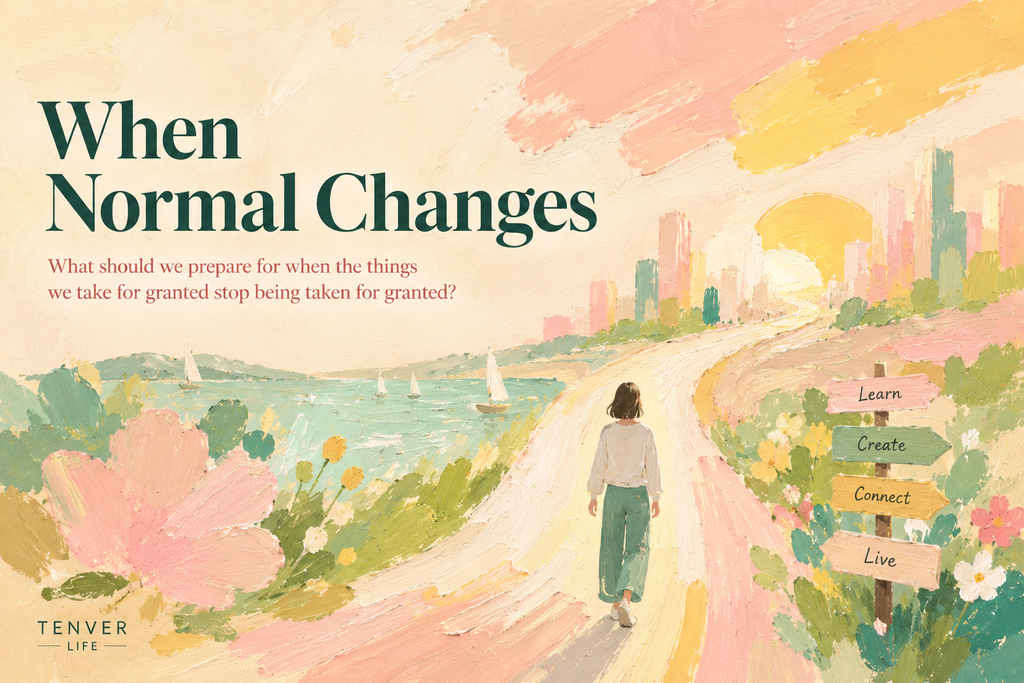
It is tempting to say that we should reinvest our recovered capacity in “higher-value” things. But higher by whose measure? Is writing one more paper inherently more valuable than spending two hours with a grandchild? Is starting another business more worthwhile than taking a long afternoon walk? If AI lets us finish early and we read a book, is that productive—but if we finally get enough sleep, is that wasted time?
There is no universal ranking. Technology can create new possibilities for us. It cannot decide what constitutes a better life.
For one person, the answer may be learning or building a business. For another, family, health, friendship, or creativity. For someone else, it may simply be rest that has been postponed for too long.
What matters is not some abstract category called “higher value.” It is what we consider important enough to receive our finite time and attention.
The Day the Old Way Starts to Look Strange
So what should we prepare for when normal begins to change?
We cannot learn every new technology that appears, nor should we try. But we can watch what is happening in our own lives. What am I spending significant time doing that is rapidly becoming easier? What do I still think of as a skill that is becoming a baseline capability? As that ability becomes common, what is becoming newly scarce? And of the capacity created by these changes, how much is actually becoming mine?
These questions will not predict the future. But if we watch technologies unbundle abilities and make some of their components abundant, we may begin to see where scarcity is disappearing—and where it is beginning to reappear.
Preparing for the future may not mean learning everything the future will require. It may mean noticing a little earlier what is becoming ordinary, and what becomes scarce because of it. Then we can reconsider where to place our own time and attention.
We do not need to know the exact destination. Seeing the direction may be enough to begin moving.
Normal rarely changes in a single dramatic moment. First, something new is remarkable. Then it becomes an option. Eventually, it becomes the default.
And after a little more time, something curious happens:
The new thing stops looking remarkable. The old way starts looking strange.
That is when one version of normal quietly ends.
Perhaps future generations really will ask: “People used to drive cars themselves?” “You opened dozens of websites one by one just to find information?” “People wrote the first draft of a report from scratch?”
At the beginning of this essay, we let a child from the future look back at us. Perhaps now we should stand where that child is standing and look at our own present from the same distance.
Of all the things I take for granted today, which one will my future self find hardest to believe?
And if the day comes when I no longer have to do it myself—
What will I put in the space it leaves behind?
TENVER VIEW
Perhaps preparing for a shift in what we consider normal is less about predicting the future than about learning to see the present as strange before the future arrives.
Notice a little earlier what is becoming abundant, what becomes scarce as a result, and how much of the capacity created by that change actually becomes yours.
If something truly does come back to you, move some of your finite time and attention—perhaps a little earlier than you otherwise would—toward what you believe matters most.
AI does not give us the future.
It gives us possibilities.
Which of those possibilities will actually become ours? And what will we do with them?
Perhaps the shape of the next era will depend not only on how far technology advances, but also on how we answer those two questions.
Leave a Reply