For most of modern medicine, cancer treatment has followed a familiar model: identify the type of cancer, then choose the best available treatment for it. But cancer is not quite that simple. Two people can have melanoma, yet the mutations driving their tumors may be very different.
What if, instead of giving both patients essentially the same medicine, we could build part of the treatment specifically for each person’s cancer? That possibility just moved an important step closer to reality.
A Milestone for Personalized Cancer Therapy
On August 19, 2026, Moderna and Merck announced that their Phase 3 INTerpath-001 trial had succeeded. The study involved 1,137 patients with high-risk stage IIB–IV cutaneous melanoma whose tumors had been completely removed by surgery. Researchers compared Merck’s immunotherapy drug Keytruda alone with Keytruda plus intismeran autogene, also known as V940 or mRNA-4157—an individualized mRNA therapy manufactured specifically for each patient.
The combination significantly improved both recurrence-free survival and distant metastasis-free survival compared with Keytruda alone. That matters because Phase 3 is where many promising experimental treatments fail. This trial cleared that critical hurdle.
According to Moderna and Merck, this is the first positive Phase 3 trial of an individualized neoantigen therapy—and of an mRNA-based cancer therapy.
How Do You Make a Cancer Treatment for One Person?
The idea is remarkably elegant. Doctors begin with the patient’s own tumor. Scientists sequence it and search for mutations that produce abnormal proteins called neoantigens—molecular signatures that distinguish the cancer cells from normal cells.
From those mutations, they select targets unique to that patient’s cancer. Then they manufacture an mRNA therapy carrying instructions for those targets. Intismeran can encode as many as 34 tumor-specific neoantigens.
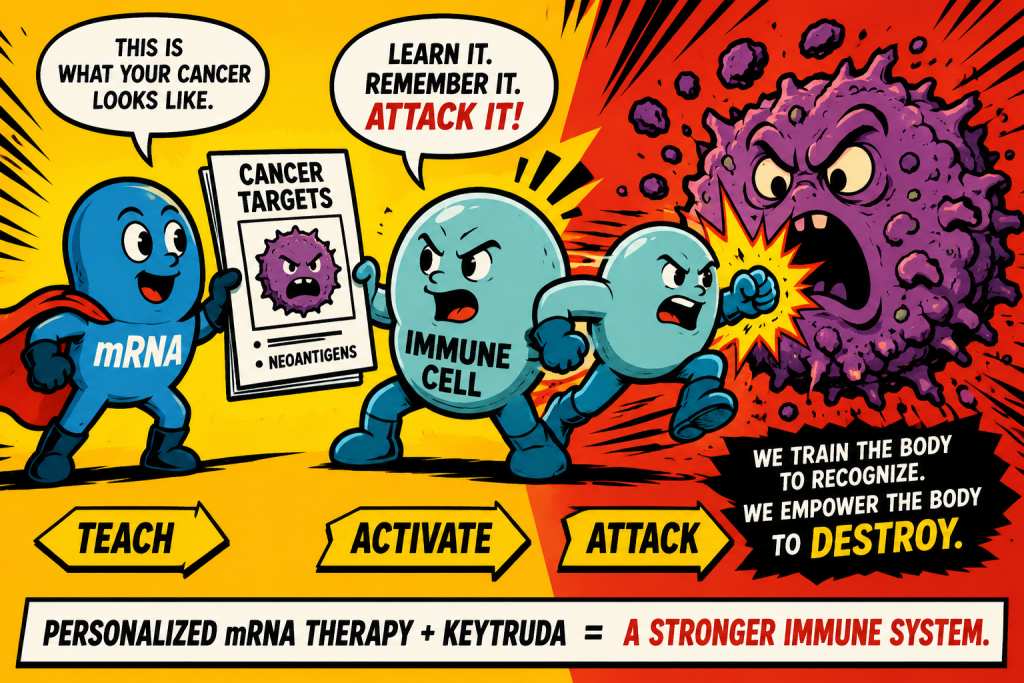
Once administered, the mRNA helps train the immune system to recognize those targets. In simplified terms, the message is:
This is what your cancer looks like.
Learn it. Remember it. Attack it.
Keytruda plays a complementary role. It blocks PD-1, one of the mechanisms tumors can exploit to restrain immune cells. One treatment helps show the immune system what to attack. The other helps free it to attack.
The Earlier Results Were Already Striking
The Phase 3 announcement did not come out of nowhere. An earlier randomized Phase 2b study followed high-risk stage III–IV melanoma patients for a median of 60.3 months—about five years.
Compared with Keytruda alone, the personalized mRNA combination produced a: 49% reduction in the risk of recurrence or death and a 59% reduction in the risk of distant metastasis or death.
Those are relative risk reductions, not claims that 49% or 59% of patients were cured. That distinction matters. But five years of follow-up suggested that the benefit was durable—and the larger Phase 3 trial has now crossed another critical threshold.
Why This Could Be Bigger Than Melanoma
The most important part of this story may not ultimately be melanoma. It may be the platform. Medicine has been moving toward precision oncology for years: sequence a tumor, identify a mutation, and choose a drug that targets it.
Personalized mRNA therapy takes the concept further. Instead of merely asking:
Which existing medicine best matches this patient’s tumor?
we can begin asking:
Can we manufacture a treatment from the biological information contained in this patient’s tumor?
That is a very different idea. The medicine is no longer entirely mass-produced. Part of it becomes personal.
Moderna and Merck are already testing intismeran across multiple cancers, including melanoma, non-small cell lung cancer, bladder cancer and renal cell carcinoma. If the approach succeeds in several cancers, this melanoma trial could eventually be remembered as something much larger than a melanoma breakthrough. It could become an early milestone in the industrialization of personalized medicine itself.
Hope, Without Hype
There is also plenty we still don’t know. This is not a vaccine that healthy people can take to prevent cancer. It has not cured cancer. Intismeran remains investigational, and the companies have not yet released the detailed numerical results from the Phase 3 trial. They plan to present them at an upcoming international medical meeting and discuss regulatory filings with health authorities. We also don’t yet know whether the treatment will extend overall survival.
And personalization creates a practical challenge: every treatment must be designed and manufactured from an individual patient’s tumor. Sequencing, computational analysis, manufacturing, quality control and delivery all have to happen fast enough—and eventually cheaply enough—to make the approach practical on a large scale.
So this is not the end of the story. It may be the beginning.
The TENVER View
The breakthrough is not that we have cured cancer. We haven’t.
The breakthrough is that an idea once confined largely to experimental medicine has now succeeded in a large Phase 3 trial: Take the unique genetic fingerprint of one person’s cancer. Turn that information into mRNA. And use it to teach that person’s immune system what to fight.
For most of medical history, millions of patients have been treated with medicines manufactured identically for millions of people. Cancer may be pushing medicine toward something different.
The question is no longer simply:
Can personalized mRNA cancer therapy work?
Now we can begin asking:
How well can it work?
For how many cancers?
How quickly can we make it?
And how personal can medicine ultimately become?
Perhaps the future of cancer treatment will not be defined by finding one miraculous drug that defeats every cancer. Perhaps it will be defined by something almost opposite:
The age of treating “cancer” may slowly be giving way to the age of treating your cancer.
Key Papers & Sources
1. Moderna & Merck — INTerpath-001 Phase 3 Results (2026)
Phase 3 trial of intismeran autogene (V940) plus KEYTRUDA in high-risk melanoma
The Phase 3 trial met its primary endpoint of recurrence-free survival and its key secondary endpoint of distant metastasis-free survival.
Merck — Phase 3 INTerpath-001 Results
2. Weber JS, et al. (2024)
Individualised neoantigen therapy mRNA-4157 (V940) plus pembrolizumab versus pembrolizumab monotherapy in resected melanoma
The Lancet
This randomized Phase 2b trial provided the clinical foundation for the Phase 3 program and demonstrated improved recurrence-free survival with personalized mRNA therapy plus pembrolizumab.
3. Moderna & Merck — Five-Year Follow-Up (2026)
Long-term follow-up of KEYNOTE-942 / mRNA-4157-P201
At approximately five years of follow-up, the combination showed a 49% reduction in the risk of recurrence or death and a 59% reduction in the risk of distant metastasis or death compared with KEYTRUDA alone.
답글 남기기