English | ଓଡ଼ିଆ
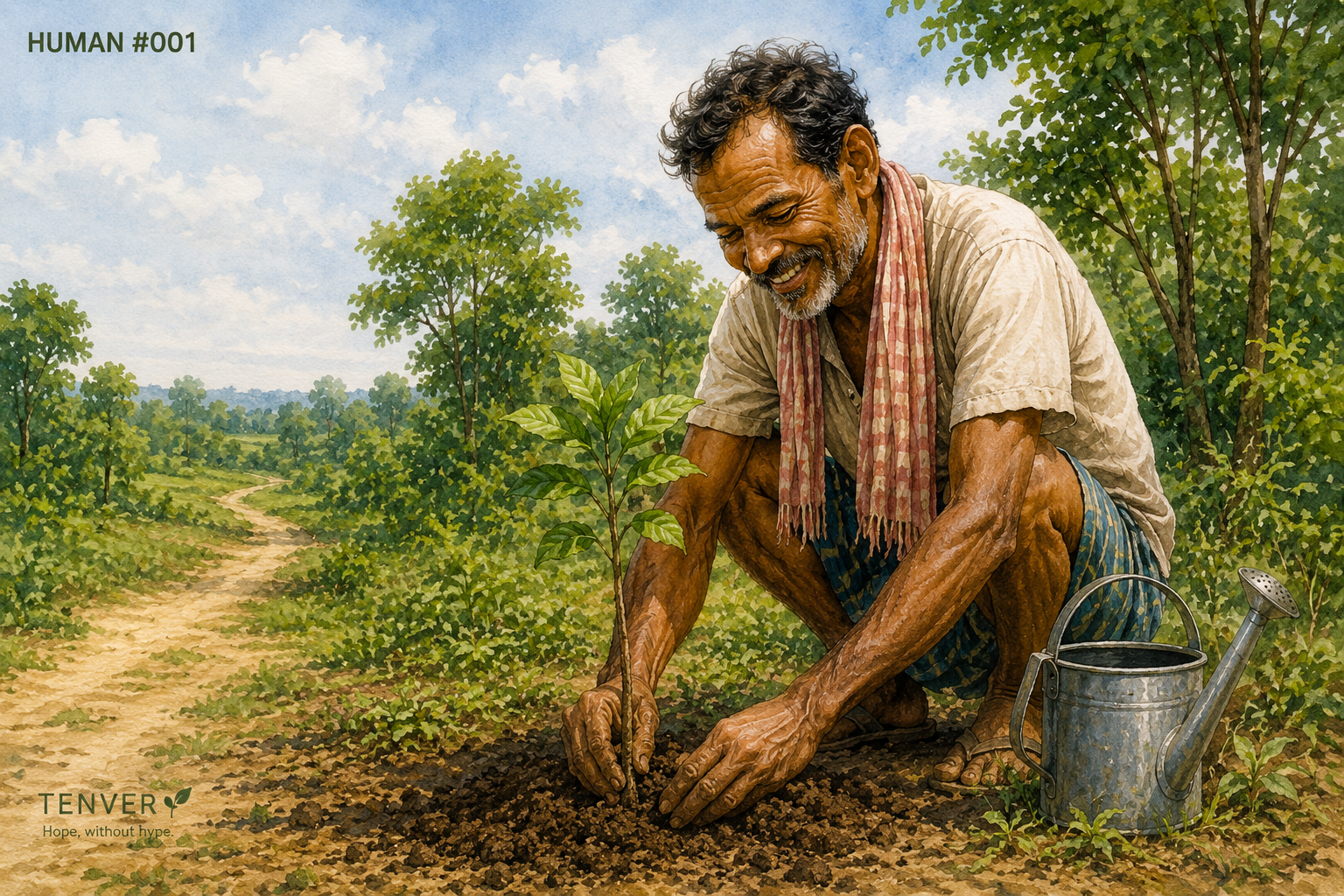
Gunthiram Jena began planting trees when he was about 20. Forty-five years later, that small decision has left a living mark across his corner of eastern India.
Editorial illustration based on reported details of Jena’s tree-planting work in Odisha. It is not a photograph of Gunthiram Jena.
In 1953, the French writer Jean Giono published The Man Who Planted Trees.
Its central character, Elzéard Bouffier, is a shepherd living alone in a barren part of Provence. He begins doing something no one has asked him to do: selecting acorns and planting them, one by one.
Over the years, a forest rises from the desolate land.
Water returns. So does life.
The story was so convincing that some readers believed Bouffier had been a real person.
He was not.
Gunthiram Jena is.
Jena is a daily-wage laborer from Uasahi, a village in the Jajpur district of Odisha in eastern India. A 2025 report described him as 65. For roughly 45 years, alongside the work he does to earn a living, he has been planting and caring for trees.
Over the years, Jena is estimated to have planted around 100,000 saplings.
But the precise number may be the least important part of his story. No one appears to have counted every tree he put into the ground.
What matters more is something easier to establish and harder to dismiss:
For roughly 45 years, he kept planting.
The number is an estimate. The persistence is not.
A Radio and 45 Years
Jena was about 20 when, around 1980, he heard a radio program about afforestation.
He had no training in forestry. He did not belong to an environmental organization. This was not a government project.
Something about the program stayed with him, and he began planting trees.
Mango. Jackfruit. Coconut. Guava. Bael. Banyan.
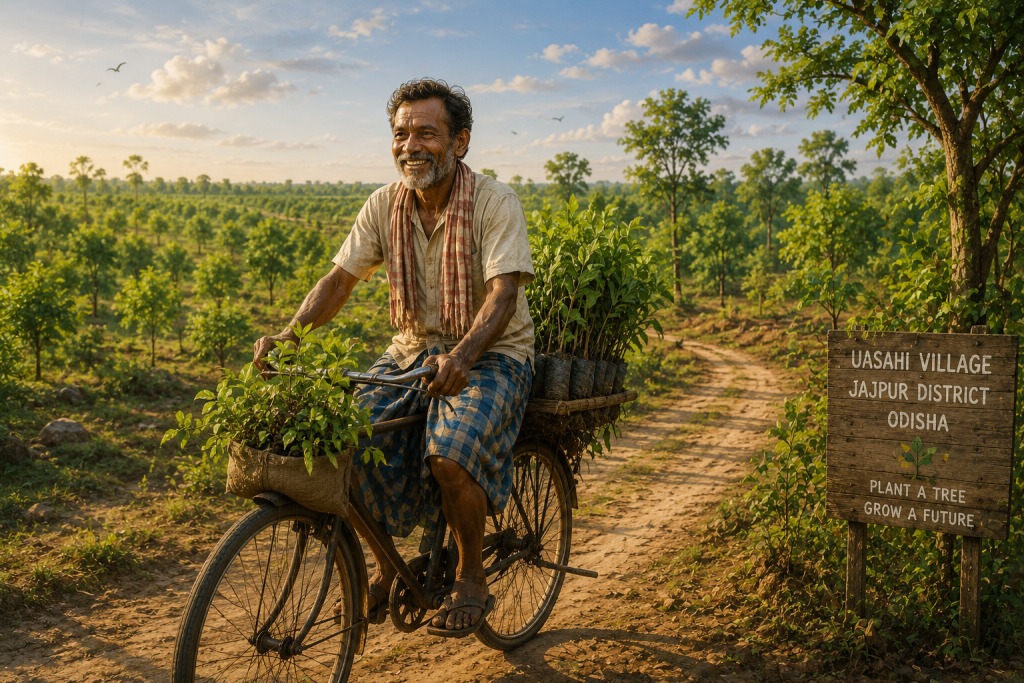
When his day’s paid work was finished, Jena would gather seeds, saplings and a spade and head out again. At times he carried a bag of seeds and young plants on an old bicycle, traveling through villages in search of places where trees could grow.
It was not his job.
No one was paying him to do it.
In 2025, his daily wage was reported at about 400 rupees, roughly US$4 to $5 at the time. Some of that modest income went toward rope, gunny bags and other materials used to protect young trees.
Months became years.
Years became decades.
The Harder Part Comes After Planting
Jena did not simply put saplings into the ground and leave them there.
He carried water from nearby sources, protected young trees and returned to help them take root and survive.
That distinction matters.
Planting can be a moment. Keeping something alive is a practice.
The Mind of Someone Who Plants
Anyone who has planted a seed or a young tree knows something about what happens afterward.
You may leave the place where you planted it, but your mind does not entirely leave with you.
Several days without rain become a concern. Too much rain can be a concern, too. A stretch of punishing heat or a night of hard wind looks slightly different when something you planted is out there in it.
Eventually, you go back to look.
Jena went back.
He watered the young trees, protected them and planted more.
He kept doing it for decades.
While the World Moved On
Forty-five years is a long span in a human life.
Jena began planting around 1980.
India changed. Odisha changed.
In 1999, the Odisha super cyclone, one of the most destructive natural disasters in India’s modern history, struck the state. Powerful winds, storm surge and flooding killed thousands and devastated homes, farmland and vegetation.
By then, Jena had already been planting trees for nearly two decades.
He continued after the cyclone, including in areas where vegetation had been damaged.
Summer followed summer.
Monsoons came and went.
Not every sapling he planted survived.
But Jena kept planting.
The Scale of One Man’s Work
One familiar place offers a sense of scale.
New York’s Central Park covers 843 acres and contains about 18,000 trees. Those trees are cared for by professional arborists within an organized system of stewardship.
Jena had no such organization behind him.
He had a bicycle and a spade—and whatever time remained after the day’s work was done.
A person planting a few trees after work does not change a landscape overnight. A year may pass without anything that looks dramatic.
Forty-five years is different.
He did not begin by doing something enormous.
He did something small for long enough to produce an enormous result.
When People Began to Notice
People around Jena did not always regard what he was doing as remarkable.
Some villagers questioned why a daily-wage laborer would spend his own time and money planting trees after work. His wife, according to one report, sometimes worried about the money he spent protecting saplings.
Jena continued anyway.
Eventually, the way people saw him changed.
He became known locally as the “Tree Man,” and local organizations recognized his environmental work.
The sequence matters.
Jena did not begin planting because people recognized him. People began recognizing him because he kept planting.
The Family Who Shared the Years
Jena is a husband and father of three daughters. His daughter Nikita has spoken proudly about what her father has done.
But 45 years did not pass for him alone.
While he worked for wages and spent part of his remaining time and limited income on trees, his family lived through those same years beside him.
What Recognition Changed
Recognition did not arrive early.
In 2025, local reporting still described Jena and his family as living in a modest thatched home while he continued working as a daily-wage laborer. The family had reportedly sought help securing more permanent housing.
Then something changed.
After learning about Jena’s work, the Raghu Arikapudi Seva Trust stepped in. By October 2025, it had built a permanent two-room house for Jena and his family at a reported cost of ₹500,000.
The house was given a fitting name:
Prakruthi Nilayam — “Nature’s Home.”
A housewarming was held, and the organization said at the time that a kitchen and washroom were also planned.
Recognition, after decades, had finally produced a tangible change in the family’s daily life.
What a Small Decision Became
There is little reason to measure Gunthiram Jena against large environmental projects.
Governments can plant millions of trees. International organizations and corporations can deploy enormous budgets, professional staffs and sophisticated forestry programs.
What Jena did was much simpler.
At about 20, he heard a radio program about planting trees.
He began planting.
And for roughly 45 years, he did not stop.
Over those years, many of the saplings he planted grew into trees. They produced shade and fruit and created places for birds and other forms of life.
Our Turn to Notice
Long before we knew his name, the saplings planted by Gunthiram Jena’s hands—and tended by those same hands as they grew into trees—may already have been paying tribute to him in their own quiet way.
Now it is our turn to recognize the life behind them.
TENVER HUMAN introduces Gunthiram Jena as its first subject and pays tribute to the persistence with which he carried a simple conviction for decades, and to the remarkable result that persistence has produced.
We extend that same tribute to his family, who stood beside him and shared the long years of a journey that could not always have been easy.
TENVER HUMAN
TENVER HUMAN documents people who, in their own place and in their own way, have spent years leaving meaningful traces on the world.
We do not try to turn them into heroes. We look carefully at the paths they have already walked, connecting scattered records and memories so their lives can be more fully seen and their stories carried into a wider world.
We also seek out memories before they disappear—connecting fragments of the past with lives still being lived today.
Remembering the footprints they leave behind. That is why TENVER HUMAN goes looking for them.
Do You Know Someone We Should Know?
Some remarkable lives are never written down.
Perhaps it is someone in your town, your family, or someone you have quietly watched for years.
If you know a person whose story deserves to be remembered before it disappears, tell TENVER about them.
You don’t need to write the story. Just tell us who they are, what they have done, and why you think we should know them.
TENVER will take it from there—researching the records, listening to the people who remember, checking the facts, and looking for the larger story their life may hold.
Tell us about someone we should know.
Selected Sources
The Times of India — June 8, 2025: Jena’s village, age reported at the time, daily-wage work, radio inspiration, roughly 45 years of planting, estimated number of saplings, tree care, family and local recognition.
OMMCOM News — Aug. 19, 2025: Jena’s bicycle-and-spade routine, planting across multiple panchayats, the 1999 cyclone context, recognition and the family’s housing difficulties.
Telangana Today — Oct. 15, 2025: construction of Prakruthi Nilayam, the two-room permanent house provided for Jena and his family.
Central Park Conservancy — Central Park’s 843 acres, approximately 18,000 trees and professional stewardship.
Leave a Reply